Explained: What is in the GLOW peptide blend?
What GHK-Cu, BPC-157 and TB-500 are, why GLOW’s vial reads 50/10/10 mg, and how the numbers fall out once the powder is in solution.
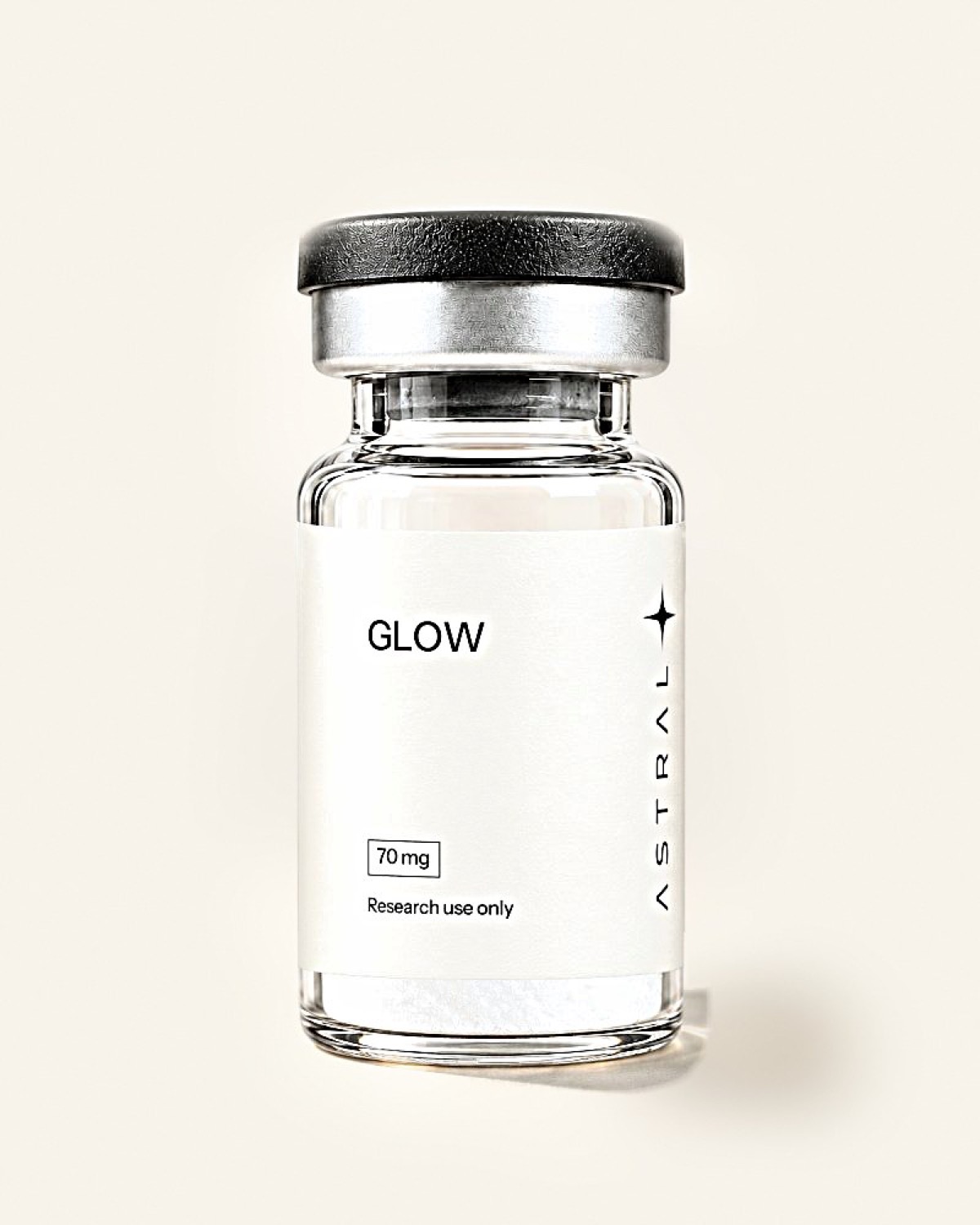
GLOW is a research peptide blend of GHK-Cu, BPC-157 and TB-500, supplied as one co-lyophilized vial holding 50 mg, 10 mg and 10 mg of the three in that order. The components were dissolved together and freeze-dried into a single powder, so every vial carries 70 mg of peptide in a fixed 5:1:1 mass ratio. Astral supplies GLOW for laboratory research only, and each released lot has its certificate on the GLOW certificate page.
Table of contents
What is in a GLOW vial?
Three peptides, in the same amounts the Index lists them at on their own. The label reads 50/10/10 mg.
| Component | Amount per vial | Identity |
|---|---|---|
| GHK-Cu | 50 mg | Gly-His-Lys complexed with Cu²⁺, CAS 89030-95-5, 403.93 g/mol |
| BPC-157 | 10 mg | 15-residue synthetic peptide, CAS 137525-51-0, 1419.56 g/mol |
| TB-500 | 10 mg | TB-500, as listed on its own product page |
GHK-Cu is the small one: glycyl-L-histidyl-L-lysine, three amino acids, with a copper(II) ion bound to it. The 1988 FEBS Letters paper the product page cites opens by describing the tripeptide as having an affinity for copper(II) and being isolated from human plasma, and the copper complex is what Astral lists, C14H24CuN6O4 at 403.93 g/mol. The copper is in the formula, and it is the reason the solution carries a blue tint once the powder is mixed.
BPC-157 runs 15 residues, with three prolines in a row near the N-terminus, and at 1419.56 g/mol each molecule weighs about three and a half times what a GHK-Cu molecule does. It is synthetic. Its sequence comes from a gastric protein, and it also goes by the code PL-14736.
The third component is TB-500, 10 mg of it, the same compound Astral lists on its own. Its product page carries the full listing.
Why the ratio is 50/10/10
Those are the sizes the three compounds come in on their own. GHK-Cu is listed at 50 mg, BPC-157 at 10 mg and TB-500 at 10 mg, and GLOW is those three amounts in a single vial. The ratio is by mass. That is how the label reads and how the arithmetic further down works.
Fifty milligrams of GHK-Cu at 403.93 g/mol comes to about 124 µmol. The 10 mg of BPC-157 at 1419.56 g/mol is about 7 µmol. So on a molar basis the tripeptide outnumbers BPC-157 by roughly 18 to 1, and by count the blend is overwhelmingly GHK-Cu whatever the label says, which is worth a line in the notebook if your work runs in molarity.
What “co-lyophilized” means
Lyophilization is freeze-drying. The filled solution is frozen, the ice is pulled off as vapor under vacuum, and the last of the bound water is driven out at a slightly higher temperature. The FDA’s inspection guide for lyophilized parenterals describes exactly those three stages, freezing, primary drying by sublimation and secondary drying by desorption, and what is left is a dry cake that goes back into solution when solvent is added.
“Co-” means the three peptides shared that solution before it was frozen, in one fill, and the cake that comes out has all three mixed through it at the molecular level. You cannot weigh out one component from the powder, since the three are no longer separate solids, and the ratio was fixed when the vial was filled, so 50/10/10 is the only composition this vial can ever give you. When you reconstitute, all three go into solution at the same moment, at concentrations that follow from the single volume you chose. If your work needs the proportions to move, the three single-compound vials are the route, since each one dissolves on its own.
What the literature studied, component by component
No published study evaluates the GLOW combination. The product page’s research registry cites three papers, one per constituent, and each looked at a single peptide on its own, in cultured cells or with purified protein. None involved a blend, people, or an Astral lot.
The GHK-Cu paper is Maquart and colleagues in FEBS Letters, 1988, who added the copper tripeptide to cultured fibroblasts, measured collagen synthesis across concentrations from 10⁻¹² to 10⁻⁹ M, and reported no change in cell number over that range. For BPC-157 it is Chang and colleagues in Molecules, 2014, working with tendon fibroblasts isolated from rat Achilles tendon and measuring growth hormone receptor mRNA and protein after exposure to BPC-157, along with JAK2 activation. The third is Safer, Sosnick and Elzinga in Biochemistry, 1997, a biophysics study of thymosin beta-4, the protein the TB-500 name points back to, which used circular dichroism, NMR and cross-linking to map how it sits on actin. Mostly unstructured on its own. Bound, its C-terminal half lies extended along the actin monomer, touching both the barbed and the pointed end.
Supply, storage and the reconstitution arithmetic
GLOW ships as a lyophilized powder in one vial, labeled 50/10/10 mg. The label carries a lot number, and purity is listed at 99% or above. As of October 2026 the released lot is AST-GLOW-001, analyzed by Janoshik Analytical on 2026-07-27, and its certificate is filed on the GLOW certificate page in the COA library. Store the vial like any other lyophilized peptide. The storage guide has the windows, and the mixing is the same as well: Reconstitution Solution run down the inside of the glass, then a slow swirl, as the reconstitution guide walks through step by step.
The arithmetic is the single-peptide arithmetic done three times with one volume. Mass over volume, per component. Add 2 mL and the vial gives 25 mg/mL GHK-Cu, 5 mg/mL BPC-157 and 5 mg/mL TB-500, 35 mg/mL of peptide in total. Add 1 mL and each figure doubles to 50, 10 and 10 mg/mL. The 2 mL case is an example, and the volume is a choice you make for your own work. The peptide calculator does the division for any vial: enter each component’s mass against the same solvent volume and you have all three concentrations for the label.
Why is the solution blue?
Copper. Every GHK-Cu molecule carries a copper(II) ion, and copper(II) in solution absorbs light toward the orange and red end of the spectrum, so what passes through to your eye is blue. The color deepens with concentration, so a 25 mg/mL solution from a 2 mL fill is plainly blue, and the storage guide lists blue as the one color that counts as normal for this vial. Cloudiness, specks, a film, or any color other than blue are a different matter, and a solution showing them should be discarded.
Common questions
Is “glow stack peptide” the same thing as GLOW?
Searches for “glow stack” and “glow blend” usually mean this same three-peptide combination of GHK-Cu, BPC-157 and TB-500. Astral’s GLOW is the single-vial, co-lyophilized version at 50/10/10 mg. The same three compounds are also listed separately in the Index for work that needs them in other proportions.
What are the GLOW peptide ingredients?
GHK-Cu at 50 mg, BPC-157 at 10 mg and TB-500 at 10 mg, as the label reads. Each compound has its own product page with the full listing.
How is GLOW different from Wolverine?
Wolverine is the two-component blend, BPC-157 and TB-500, in 5/5 mg or 10/10 mg. GLOW adds 50 mg of GHK-Cu to the 10/10 pair, and the copper that comes with it. The Wolverine stack guide covers that pair on its own.
Can the three components be separated after reconstitution?
Not at the bench. Once the cake dissolves, all three are in the same solution at the ratio they were filled, and separate stock solutions mean the single-compound vials.
Has any study tested the GLOW combination?
No. The three papers cited on the product page each examined one constituent on its own, in cultured cells or with purified protein, and none of them evaluated the blend or an Astral lot.
Where is the certificate for a GLOW lot?
On the GLOW certificate page, filed by lot number. Match the number printed on your label to its record there.
Astral supplies these materials for laboratory research only. This guide describes the composition and bench handling of research material.
Sources
- Stimulation of collagen synthesis in fibroblast cultures by the tripeptide-copper complex glycyl-L-histidyl-L-lysine-Cu2+ Maquart FX, Pickart L, Laurent M, et al. FEBS Letters (1988)
- Pentadecapeptide BPC 157 enhances the growth hormone receptor expression in tendon fibroblasts Chang CH, Tsai WC, Hsu YH, Pang JH. Molecules (2014)
- Thymosin beta 4 binds actin in an extended conformation and contacts both the barbed and pointed ends Safer D, Sosnick TR, Elzinga M. Biochemistry (1997)
- Lyophilization of Parenteral (7/93), Inspection Guide U.S. Food and Drug Administration