Explained: What is GHK-Cu, the copper peptide?
A three-amino-acid peptide carrying one copper ion, how it differs from plain GHK, why its solution is blue, and what the published literature has studied it in.
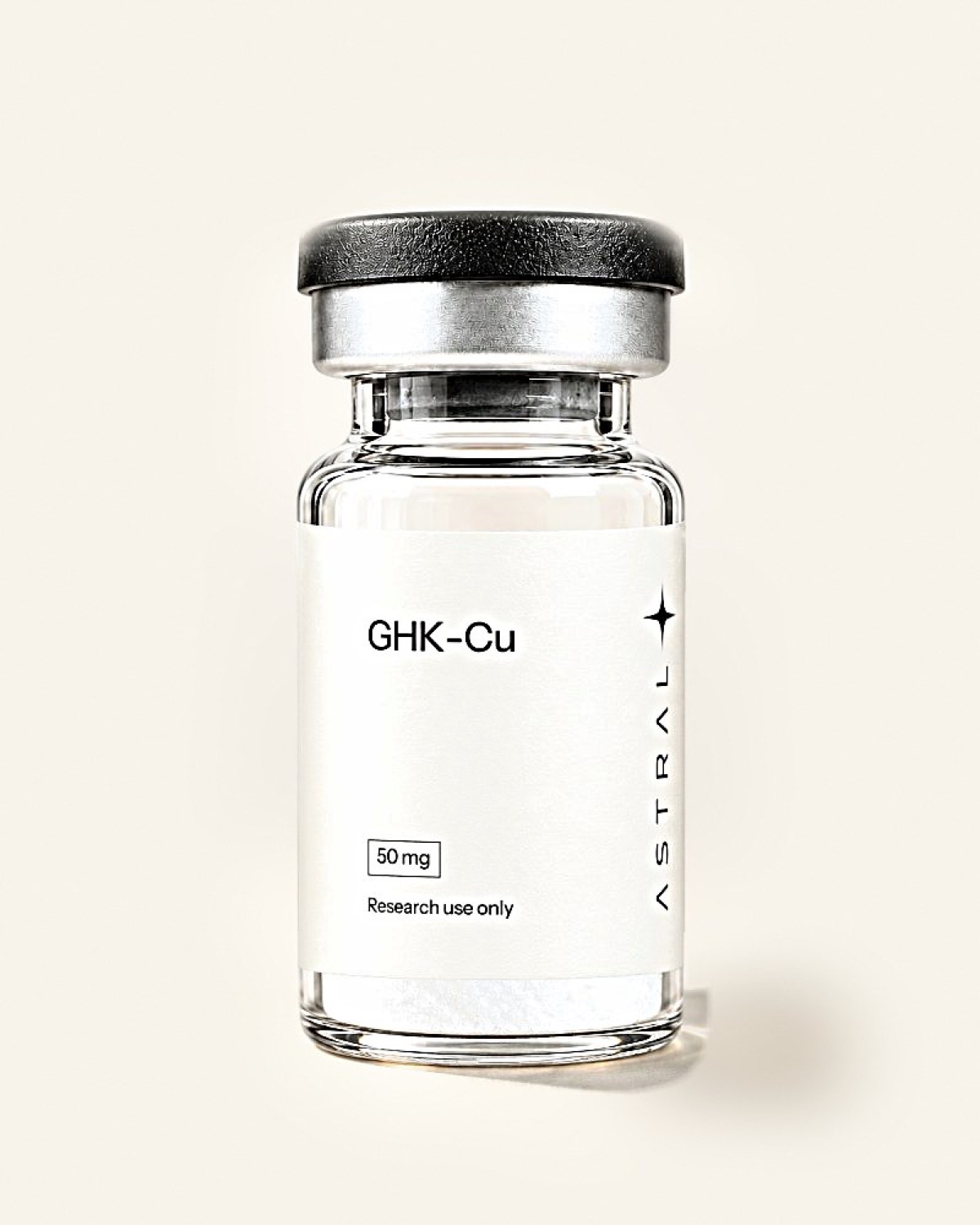
GHK-Cu is a small peptide of three amino acids, glycine, histidine and lysine, with one copper(II) ion bound to it. The bare peptide is GHK, glycyl-L-histidyl-L-lysine, first isolated from human serum in 1973. Adding the copper gives the complex its full name and the blue of its solution, and the literature keeps the copper form and the bare peptide apart.
Four names turn up for it. GHK-Cu and GHK-Cu(II) are one complex written two ways, the Roman numeral spelling out the copper’s +2 charge. Copper tripeptide-1 is the same complex again. Glycyl-L-histidyl-L-lysine is the full chemical name of the peptide half, which is what the 1988 FEBS Letters paper used with “-Cu2+” tacked on the end, while the 1980 Nature paper went the other way and shortened the peptide to GHL.
Table of contents
Is GHK-Cu a peptide?
Yes. A tripeptide, three amino acids joined by two peptide bonds, with a metal ion attached, so the strict description is a metal-peptide complex, GHK for the peptide and Cu for the copper.
Three residues is short. For scale, BPC-157, which shares a vial with GHK-Cu in GLOW, runs 15 amino acids. With the copper on board the whole GHK-Cu complex comes to 403.93 g/mol, and the copper alone is about 16 percent of that mass.
The copper is held by the two side chains in the middle and at the end of the chain. In 1980 Pickart and colleagues reported in Nature that the peptide came out of plasma with roughly one copper for every peptide, and that other tripeptides which kept the histidine-lysine pair were nearly as active in their cell assays, which pointed at those two residues as the binding site. The same paper noted the resemblance to the copper-binding sites on albumin.
GHK vs GHK-Cu: one copper ion apart
GHK is the bare tripeptide, and GHK-Cu is the same tripeptide holding one copper(II) ion. On paper the ion is the entire difference, and in the literature the two are studied separately, so a paper worth citing says which one it used.
The copper work begins with that 1980 Nature paper, which reported that GHK forms complexes with copper(II) readily and, in cultured hepatoma cells, raised the uptake of copper into the cells. The authors proposed a role for the peptide as a copper carrier. Choi and colleagues did the opposite in 2012 and studied copper-free GHK on purpose, in cultured human keratinocytes and a lab-grown layered tissue model, with the copper form run alongside as the comparison. They reported similar results for the two and said the relationship between them needed more work. So that paper belongs to the bare peptide, with the copper form appearing only as its comparison arm.
Astral stocks the copper complex. The sequence on the product page reads Gly-His-Lys : Cu²⁺, and the copper sits in the formula.
Where GHK comes from
Human serum, first. Pickart and Thaler isolated a tripeptide from it in 1973 and reported the work in Nature New Biology. The 2015 review from Pickart’s group lists plasma, saliva and urine as places it has since been measured.
The sequence also sits inside a structural protein. Maquart and colleagues pointed out in 1988 that Gly-His-Lys occurs in the α2 chain of type I collagen, and suggested, as a hypothesis, that proteases cutting collagen apart could release the tripeptide.
Why is GHK-Cu blue?
Because of the copper. Copper(II) in a complex absorbs light toward the red end of the spectrum, and what gets through to your eye is blue. Take the copper away and a plain tripeptide is left, and short peptides like that dissolve clear.
In a reconstituted vial the color is a clear blue, deeper the more concentrated the solution. Both the reconstitution guide and the storage guide call it normal, and GHK-Cu is the one compound in the catalog you should expect color from, with GLOW inheriting it. Cloudiness, specks, or a shift toward any color other than blue is a different matter, and the storage guide covers what those mean.
What has GHK-Cu been studied in?
Cell cultures, mostly, plus reviews that gather up the cell and gene-expression work. Six papers sit on this page’s source list.
The oldest is the 1973 isolation paper from Pickart and Thaler, which reported a tripeptide from human serum and its effect on cultured liver cells. PubMed holds no abstract for it, so the title is the record. Seven years later the same group’s Nature paper, in cultured hepatoma cells, reported that the peptide complexes copper(II), increased copper uptake into the cells, and might serve as a copper carrier. Then Maquart and colleagues in 1988, in fibroblast cultures, measured collagen synthesis and reported an increase that began between 10⁻¹² and 10⁻¹¹ M and peaked near 10⁻⁹ M while cell number stayed flat. Picomolar to nanomolar. The flat cell count mattered to them because it separated output per cell from a plain rise in the number of cells.
Choi and colleagues, 2012, is the copper-free keratinocyte study covered above, labeled copper-free throughout this guide because that is what the authors studied.
The two reviews are both from Pickart, Vasquez-Soltero and Margolina. The 2012 one gathers proposed roles for GHK-Cu in oxidative stress and copper handling and runs no experiments of its own, and Astral’s research registry files it as a hypothesis-level review. The 2015 one summarizes the cell-signaling pathways the group associates with GHK and gives the authors’ own figure, at least 4,000, for the number of human genes whose expression they associate with GHK.
None of that tells you what is in a given vial. For that there is the Certificate of Analysis, lot by lot, and every released GHK-Cu lot is filed on the GHK-Cu certificate page.
GHK-Cu at a glance
| Field | Value |
|---|---|
| Identity | GHK-Cu, copper tripeptide. Also written GHK-Cu(II) and copper tripeptide-1 |
| Sequence | Gly-His-Lys : Cu²⁺ (glycyl-L-histidyl-L-lysine with copper(II)) |
| CAS | 89030-95-5 |
| Formula | C14H24CuN6O4 |
| Molecular weight | 403.93 g/mol |
| Form | Lyophilized powder |
| Vial sizes | 50 mg and 100 mg |
| Certificates | Lots AST-CU-001 and AST-CU100-001 |
How Astral supplies GHK-Cu
As a lyophilized powder in 50 mg and 100 mg vials, at 99%+ purity, with a Certificate of Analysis for each released lot. As of October 2026, two lots are on the record on the GHK-Cu certificate page: AST-CU-001 for the 50 mg vial, 99.88%, and AST-CU100-001 for the 100 mg vial, 99.6%, both analyzed by ILS Laboratories on 2026-08-10. The GHK-Cu product page carries the identifiers in the table above. GLOW is the blend that contains it, 50 mg of GHK-Cu with 10 mg of BPC-157 and 10 mg of TB-500 in a single vial, so the GHK-Cu portion of a GLOW vial matches the smaller single vial, and GLOW’s own lots are filed on the GLOW certificate page.
Both arrive dry. The reconstitution guide walks through taking a sealed vial to a clear solution with Reconstitution Solution, and the peptide calculator turns the vial contents and the solvent volume into a concentration for the label. With GHK-Cu the finished solution should be clear and blue. Write down how it looked on the day you mixed it.
Common questions
Is copper tripeptide-1 the same as GHK-Cu?
They are. Copper tripeptide-1, GHK-Cu, GHK-Cu(II) and glycyl-L-histidyl-L-lysine-Cu2+ all name one complex, the tripeptide Gly-His-Lys with a copper(II) ion bound to it, under CAS 89030-95-5.
What does Cu(II) mean?
Copper in the +2 oxidation state. A formula writes it Cu²⁺ and a name writes it Cu(II), and the two notations mean the same thing.
Is the GHK-Cu in GLOW the same compound?
It is. GLOW’s 50 mg of GHK-Cu is the same copper complex sold on its own, alongside 10 mg each of BPC-157 and TB-500.
How should GHK-Cu be stored?
Like any lyophilized peptide: sealed, dry, dark and cold, and brought to room temperature before the vial is opened. Once mixed, refrigerate it. The storage guide gives the windows. Blue is normal, and a change away from blue is a reason to discard the vial.
Is GHK-Cu for use in people?
No. Astral supplies it for laboratory research only. The product page and the certificate describe the material and its paperwork, and this guide describes how to handle it at the bench.
Tools & records
Two pages on this site back up the facts above. The peptide calculator does the concentration arithmetic for a 50 mg or 100 mg vial, and the COA library holds the Certificate of Analysis for each released lot of GHK-Cu and GLOW, so the lot number on a vial can be matched to its record.
Astral supplies these materials for laboratory research only. This guide describes the identity, paperwork and bench handling of research material.
Sources
- Tripeptide in human serum which prolongs survival of normal liver cells and stimulates growth in neoplastic liver Pickart L, Thaler MM. Nature New Biology (1973)
- Growth-modulating plasma tripeptide may function by facilitating copper uptake into cells Pickart L, Freedman JH, Loker WJ, et al. Nature (1980)
- Stimulation of collagen synthesis in fibroblast cultures by the tripeptide-copper complex glycyl-L-histidyl-L-lysine-Cu2+ Maquart FX, Pickart L, Laurent M, et al. FEBS Letters (1988)
- The human tripeptide GHK-Cu in prevention of oxidative stress and degenerative conditions of aging: implications for cognitive health Pickart L, Vasquez-Soltero JM, Margolina A. Oxidative Medicine and Cellular Longevity (2012)
- Stem cell recovering effect of copper-free GHK in skin Choi HR, Kang YA, Ryoo SJ, et al. Journal of Peptide Science (2012)
- GHK Peptide as a Natural Modulator of Multiple Cellular Pathways in Skin Regeneration Pickart L, Vasquez-Soltero JM, Margolina A. BioMed Research International (2015)