Explained: What is KPV peptide (Lys-Pro-Val)?
What KPV is, where its three letters come from, what the Dallas, Münster and Emory studies measured in cells and mice, and how it differs from BPC-157.
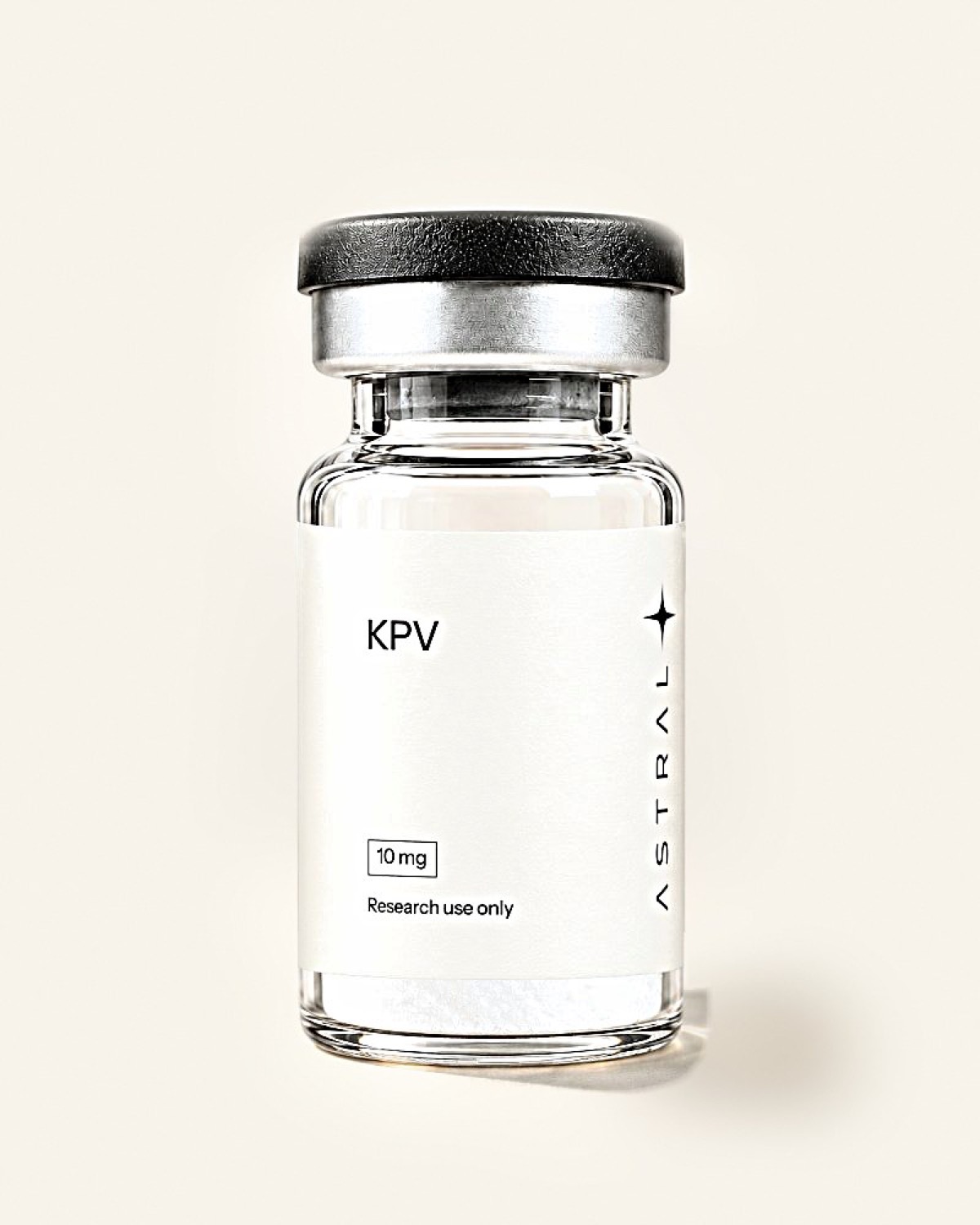
KPV is a three-amino-acid peptide, Lys-Pro-Val, cut from the tail end of α-MSH, a 13-amino-acid hormone the body makes. The name is the one-letter code for lysine, proline and valine, read in order. In the literature it goes by α-MSH(11-13), because those are the three positions it occupies in the parent hormone. Astral lists KPV as a freeze-dried powder in a 10 mg vial, CAS 67727-97-3.
It turns up in searches next to BPC-157, and as the K in KLOW. Here is what it is, who first studied it, what the colitis papers measured, and how it compares with the peptides it gets confused with.
Table of contents
What is KPV made of?
Three amino acids and nothing else: lysine, proline and valine, joined by two peptide bonds. The molecular formula is C16H30N4O4 and the molar mass is about 342.4 g/mol, which makes it one of the smallest peptides in the Astral catalog. BPC-157, for comparison, runs 15 residues.
The parent is α-MSH, short for α-melanocyte-stimulating hormone. It is a tridecapeptide, meaning 13 amino acids, and the body cuts it out of a larger precursor protein called proopiomelanocortin. Its full sequence is Ac-Ser-Tyr-Ser-Met-Glu-His-Phe-Arg-Trp-Gly-Lys-Pro-Val-NH₂. Count to the end and the last three residues are Lys, Pro, Val. KPV is that ending, made in a lab as a free peptide.
| Item | Value |
|---|---|
| Catalog name | KPV |
| Also known as | α-MSH(11-13), Lys-Pro-Val, ACTH(11-13) |
| Sequence | Lys-Pro-Val (K-P-V) |
| Length | 3 amino acids |
| Parent hormone | α-MSH, 13 amino acids |
| CAS | 67727-97-3 |
| Molecular formula | C16H30N4O4 |
| Molar mass (MW) | 342.4 g/mol |
| Form | Lyophilized powder |
| Vial size | 10 mg |
Where did KPV come from?
Dallas, 1989. Hiltz and Lipton at the University of Texas Southwestern Medical Center had been studying α-MSH as a fever-lowering hormone and believed the message that did that work sat in its last three residues. They tested the tripeptide on its own, in a mouse ear-swelling model triggered by picryl chloride, and reported in the FASEB Journal that it reduced the swelling in a dose-related way. That paper is where KPV begins.
The reason researchers kept at the fragment rather than the whole hormone is pigment. α-MSH darkens skin, which is what the “melanocyte-stimulating” in its name refers to. A 2008 review in Endocrine Reviews from Brzoska, Luger and colleagues at the University of Münster laid out the problem: the full hormone had shown protective effects across many animal models of inflammation, but its pigment effect complicated that work. KPV, the review noted, kept the anti-inflammatory activity seen in those models and showed no pigmentary action at all.
Is KPV α-MSH?
No. KPV is a fragment of α-MSH, three residues out of thirteen, and it behaves differently from the whole. α-MSH acts through melanocortin receptors on the cell surface. Whether KPV does the same was an open question for years, and two 2008 papers took it on from different directions.
The Münster group, Kannengiesser, Maaser and colleagues, induced colitis with dextran sodium sulfate in mice whose melanocortin-1 receptor did not work, then treated them with KPV. Writing in Inflammatory Bowel Diseases, they reported that KPV rescued every treated animal in that group from death, and concluded that its effects were at least partly independent of the MC1 receptor.
The same year, Dalmasso and Merlin at Emory University proposed a different route in. Their Gastroenterology paper found that KPV is carried into cells by PepT1, a transporter that normally moves small peptides across the lining of the small intestine and that appears in the colon during inflammatory bowel disease. In human intestinal cell lines (Caco2-BBE and HT29-Cl.19A) and in Jurkat T cells, nanomolar KPV lowered activation of NF-κB and MAP kinase signaling and cut the release of inflammatory cytokines. In that paper’s picture, KPV is a tripeptide that gets inside cells through a peptide transporter and acts on signaling there, rather than a hormone knocking on a receptor from outside.
What did the KPV colitis studies find?
Three mouse studies form the core of the literature, all from the Emory and Münster groups. In Dalmasso’s 2008 work, KPV was added to the drinking water of mice with colitis induced by either dextran sodium sulfate or TNBS, and the authors reported a lower incidence of colitis, judged by histology and by inflammatory cytokine gene expression. Kannengiesser’s 2008 study used two models, DSS colitis and CD45RB-high transfer colitis. In the DSS model, KPV-treated mice recovered earlier, regained more body weight, and had fewer inflammatory cells and less myeloperoxidase activity in colon tissue. The transfer-colitis mice also recovered and regained weight.
The third, from Laroui and the Emory group in Gastroenterology in 2010, was about delivery. They loaded KPV into 400-nanometer nanoparticles and wrapped those in an alginate-chitosan gel that collapses in the colon, so the peptide was released where the inflammation was. In DSS mice the particles protected against inflammatory and histologic damage, and the authors calculated that the encapsulated dose was 12,000-fold lower than the amount of free KPV needed for a similar result. That number describes the delivery system as much as the peptide.
All of this is cells and mice.
Is KPV FDA-approved?
No. No drug built on KPV has been approved by the FDA, and the peptide is supplied as a research compound. Its parent has a drug cousin, though. Afamelanotide is a 13-amino-acid analog of α-MSH with two residues swapped, norleucine at position 4 and D-phenylalanine at position 7, and it still ends in Lys-Pro-Val. The FDA approved it as a 16 mg implant on October 8, 2019. The research compound with that same sequence is in the Astral catalog as Mt-I, which is the full-length hormone analog where KPV is only the tail.
KPV vs BPC-157
People compare the two because both are small, both are sold as single peptides, and both land in the same search results. Structurally they have little in common. KPV is three residues taken from a hormone the body makes. BPC-157 is a lab-made peptide of 15 residues, sold on its own and paired with TB-500 as the Wolverine blend, and its literature is a separate body of work covered in our Wolverine peptide stack guide.
| KPV | BPC-157 | |
|---|---|---|
| Length | 3 amino acids | 15 amino acids |
| Sequence | Lys-Pro-Val | 15-residue synthetic sequence |
| Origin | Tail of α-MSH, a body hormone | Lab-made |
| Explained in | This guide | Wolverine peptide stack guide |
| At Astral | Alone, and in KLOW | Alone, in Wolverine, GLOW and KLOW |
One is a fragment and the other is a construct. If you remember only that, you will not mix them up.
What is KPV in KLOW?
KLOW is Astral’s four-peptide blend, and KPV is the K. The other three are GHK-Cu, BPC-157 and TB-500, which together make up GLOW. KLOW adds 10 mg of KPV to that trio in one 80 mg vial, the same 10 mg that comes in a vial of KPV on its own. The side-by-side table, the concentration arithmetic and the question of when a separate KPV vial makes more sense are all in KLOW vs GLOW, so this page leaves them there.
Storage and handling
Cold, dry, dark and sealed until use. Freeze-dried KPV keeps for years in a freezer and a year or two in a refrigerator, and the peptide storage guide has the windows for each. Let a cold vial reach room temperature before you open it, or condensation lands on the powder.
At 342.4 g/mol, a 10 mg vial holds about 29.2 micromoles, and a 1 mg/mL solution is about 2.92 millimolar. That is a dense count of molecules for the weight, a consequence of the peptide being so short. Mixed with Reconstitution Solution, it belongs in the refrigerator at 2 to 8 °C. The peptide calculator converts any vial and volume to mg/mL, and How to reconstitute peptides walks through the steps from sealed vial to clear solution.
Common questions
Is KPV the same as BPC-157?
No. KPV is three amino acids cut from the end of the hormone α-MSH. BPC-157 is a lab-made peptide of 15 amino acids. What they share is a research field.
What does KPV stand for?
K, P and V are the one-letter codes for lysine, proline and valine, the three amino acids in the peptide, written in the order they are joined.
Is KPV α-MSH?
No. It is the last three residues of α-MSH, positions 11 to 13 of a 13-amino-acid hormone, which is why papers call it α-MSH(11-13). The whole hormone is the research compound Astral lists as Mt-I, in its afamelanotide form.
What is KPV made of?
Lysine, proline and valine, joined by two peptide bonds. Molecular formula C16H30N4O4, molar mass about 342.4 g/mol.
What is PepT1 and why does it matter for KPV?
PepT1 is a transporter in the intestinal lining that moves two- and three-amino-acid peptides into cells. Dalmasso and Merlin’s 2008 paper reported that KPV enters cells through it, which is one reason a peptide this small was studied in gut models in the first place.
Is KPV in KLOW?
Yes. KLOW is GLOW (GHK-Cu, BPC-157 and TB-500) plus 10 mg of KPV in one 80 mg vial. It is the only Astral blend that contains KPV.
Is KPV FDA-approved?
No. KPV has no FDA approval for any use. Afamelanotide, a full-length α-MSH analog that happens to end in Lys-Pro-Val, was approved in 2019, but that is a different, 13-amino-acid molecule.
Sources
- Msh (11-13) PubChem, National Library of Medicine
- Antiinflammatory activity of a COOH-terminal fragment of the neuropeptide alpha-MSH Hiltz ME, Lipton JM. FASEB Journal (1989)
- Alpha-melanocyte-stimulating hormone and related tripeptides: biochemistry, antiinflammatory and protective effects in vitro and in vivo, and future perspectives for the treatment of immune-mediated inflammatory diseases Brzoska T, Luger TA, Maaser C, et al. Endocrine Reviews (2008)
- PepT1-mediated tripeptide KPV uptake reduces intestinal inflammation Dalmasso G, Charrier-Hisamuddin L, Nguyen HT, et al. Gastroenterology (2008)
- Melanocortin-derived tripeptide KPV has anti-inflammatory potential in murine models of inflammatory bowel disease Kannengiesser K, Maaser C, Heidemann J, et al. Inflammatory Bowel Diseases (2008)
- Drug-loaded nanoparticles targeted to the colon with polysaccharide hydrogel reduce colitis in a mouse model Laroui H, Dalmasso G, Nguyen HT, et al. Gastroenterology (2010)
- Afamelanotide PubChem, National Library of Medicine
- Drugs@FDA: FDA-Approved Drugs U.S. Food and Drug Administration (2019)