Selank vs Semax: what each peptide is and how they differ
What Selank and Semax are made from, why both end in Pro-Gly-Pro, the rat and cell studies each is known for, and where the two stand with regulators.
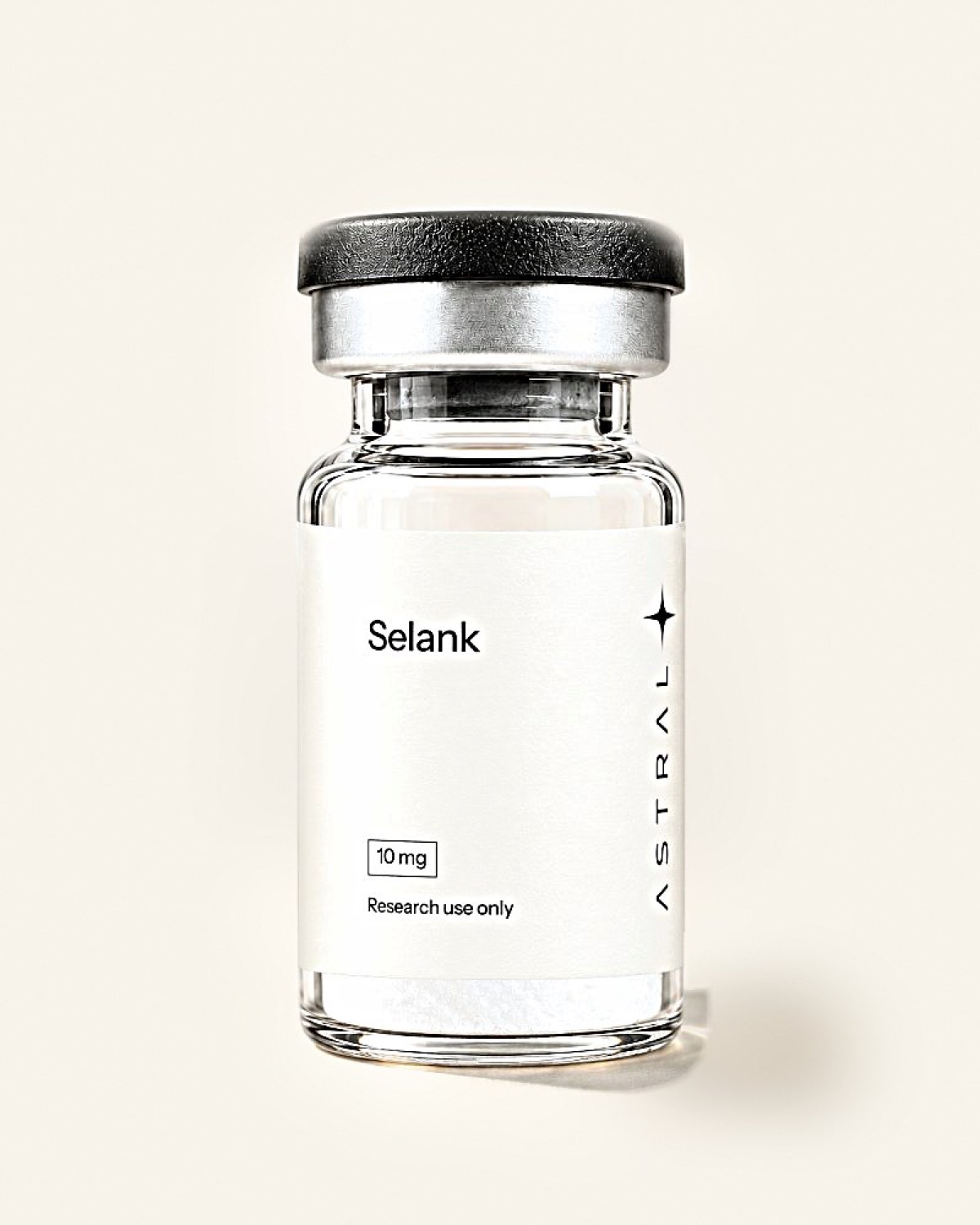
Selank and Semax are two synthetic seven-amino-acid peptides from the same Moscow laboratory, and they end in the same three residues, Pro-Gly-Pro. The front of each chain is where they part ways. Selank’s first four residues are tuftsin, a fragment of an antibody protein. Semax’s first four come from ACTH, a pituitary hormone. Astral lists Selank and Semax as freeze-dried powder in 10 mg vials.
Here is what each one is, a side-by-side table, and where they differ: in origin, in the questions researchers have put to them, and in how each is regulated.
Table of contents
What is Selank?
Selank is the heptapeptide Thr-Lys-Pro-Arg-Pro-Gly-Pro, TKPRPGP in single-letter code. The first four residues are tuftsin. Tuftsin is a natural fragment of the heavy chain of immunoglobulin G, the most common antibody in blood, and on its own it is cut apart quickly by proteases. The designers extended it at the carboxyl end with three natural L-amino acids, Pro-Gly-Pro, to make the chain harder to break down.
It was designed and produced at the Institute of Molecular Genetics of the Russian Academy of Sciences, working with the V. V. Zakusov Research Institute of Pharmacology, both in Moscow. Molecular formula C33H57N11O9, molar mass 751.9 g/mol, CAS 129954-34-3.
| Item | Value |
|---|---|
| Catalog name | Selank |
| Sequence | Thr-Lys-Pro-Arg-Pro-Gly-Pro (TKPRPGP) |
| Parent molecule | Tuftsin, Thr-Lys-Pro-Arg, from immunoglobulin G |
| Length | 7 amino acids |
| CAS | 129954-34-3 |
| Molecular formula | C33H57N11O9 |
| Molar mass (MW) | 751.9 g/mol |
| Form | Lyophilized powder |
| Vial size | 10 mg |
What is Semax?
Semax is the heptapeptide Met-Glu-His-Phe-Pro-Gly-Pro, MEHFPGP. Its first four residues are positions 4 through 7 of adrenocorticotropic hormone, ACTH, the pituitary hormone that signals the adrenal glands. The literature calls it an analog of ACTH(4-10), the seven-residue fragment Met-Glu-His-Phe-Arg-Trp-Gly. Nikolay Myasoedov’s group kept the first four of those and replaced the last three, Arg-Trp-Gly, with Pro-Gly-Pro. The natural fragment does not last, and the proline-rich tail was meant to slow the enzymes that cut it.
Same institute. The Institute of Molecular Genetics began its program on regulatory peptides in the late 1970s under Myasoedov and I. P. Ashmarin, and Semax came out of that program. Molecular formula C37H51N9O10S, molar mass 813.9 g/mol, CAS 80714-61-0. The sulfur in that formula belongs to the methionine at position 1.
Modified forms exist. N-acetyl Semax amidate carries the same seven residues with an acetyl group on one end and an amide on the other, and other analogs swap residues. Those are different molecules with different masses. The Semax that Astral lists is the plain heptapeptide.
| Item | Value |
|---|---|
| Catalog name | Semax |
| Sequence | Met-Glu-His-Phe-Pro-Gly-Pro (MEHFPGP) |
| Parent molecule | ACTH(4-7), from adrenocorticotropic hormone |
| Length | 7 amino acids |
| CAS | 80714-61-0 |
| Molecular formula | C37H51N9O10S |
| Molar mass (MW) | 813.9 g/mol |
| Form | Lyophilized powder |
| Vial size | 10 mg |
Selank vs Semax at a glance
| Selank | Semax | |
|---|---|---|
| Sequence | TKPRPGP | MEHFPGP |
| Parent molecule | Tuftsin (antibody fragment) | ACTH(4-10) (hormone fragment) |
| Residues kept from parent | Thr-Lys-Pro-Arg | Met-Glu-His-Phe |
| Shared tail | Pro-Gly-Pro | Pro-Gly-Pro |
| Molecular formula | C33H57N11O9 | C37H51N9O10S |
| Molar mass | 751.9 g/mol | 813.9 g/mol |
| CAS | 129954-34-3 | 80714-61-0 |
| Developed at | Institute of Molecular Genetics, Moscow | Institute of Molecular Genetics, Moscow |
| Russian registration | 2009 | Registered medicine |
| FDA status | Not approved | Not approved |
| Astral vial size | 10 mg | 10 mg |
How do Selank and Semax differ?
Start with the parents. Tuftsin is a piece of an antibody, which puts it on the immune side of biology. ACTH is a hormone of the stress axis. The two heptapeptides borrowed their first four residues from very different places and share only the tail, so a sequence alignment shows three matches out of seven.
That difference shows up in what researchers have asked of them. Work on Selank has leaned toward the GABA system. A 2016 study in Frontiers in Pharmacology, from the institute that made it, gave rats Selank or GABA itself and then measured 77 neurotransmission genes in the frontal cortex. One hour later, 45 of them had changed. By three hours, 22 had. Several genes for GABA-A receptor subunits were among them, including Gabrb3, Gabre and Gabrq, and the authors proposed that Selank may act as an allosteric modulator of the GABAergic system. That is a proposal drawn from expression data, not a binding measurement.
Work on Semax has leaned toward neurotrophins, the proteins that neurons use to signal growth and survival to one another. In a 2006 paper in Brain Research, Dolotov and colleagues at the institute gave rats a single application of Semax and measured the hippocampus. BDNF protein rose 1.4-fold, phosphorylation of its receptor TrkB rose 1.6-fold, and the messenger RNAs for exon III BDNF and for TrkB rose about 3-fold and 2-fold.
The same institute then ran Semax through a stroke model. In a 2010 study in Cellular and Molecular Neurobiology, rats with a permanently blocked middle cerebral artery were given Semax or Pro-Gly-Pro alone. Semax raised transcription of Bdnf, TrkC and TrkA three hours after the occlusion, and the tripeptide’s own effect only partly overlapped with it. A 2014 genome-wide follow-up in BMC Genomics looked wider. Twenty-four hours after the occlusion, more than half of the genes Semax altered belonged to the immune response, immunoglobulin and chemokine genes above all, and 24 genes tied to the vascular system had changed at three hours, 12 at twenty-four.
The one bench study that tested both side by side is the oldest. In 2001 a group at the National Research Center for Mental Health in Moscow put the two peptides up against the enzymes in human serum that break down enkephalins, the body’s small opioid peptides. Both inhibited them. Semax did so with an IC50 of 10 µM and Selank at 20 µM, far stronger than puromycin at 10 mM. Their five-residue fragments kept the effect. Three-, four- and six-residue fragments did not.
What is the Pro-Gly-Pro tail they share?
A glyproline. That is the name the Moscow groups use for short peptides built mostly from glycine and proline, Pro-Gly-Pro among them, which form in the body as collagen and elastin are broken down. Proline-rich sequences resist the common proteases, which is exactly why the designers grafted one onto tuftsin and onto the ACTH fragment. The tail is the reason both chains come to seven residues.
It is also a study subject in its own right. In the 2010 ischemia work, Pro-Gly-Pro on its own raised Bdnf and TrkC transcription at three hours, though the paper found its influence less selective than Semax’s. And in the 2001 enzyme study, the tripeptide alone had no inhibitory effect at all. The tail stabilizes. The front four residues are what make each peptide itself.
Are Selank and Semax approved anywhere?
In Russia, yes. Both are registered medicines there. Selank was registered by the Russian Ministry of Health in 2009, according to a 2013 review written by the institute that designed it. Semax is registered there as well. Neither is approved by the U.S. Food and Drug Administration.
Storage and handling
Cold, dry, dark and sealed until use. Freeze-dried peptide keeps for years in a freezer and a year or two in a refrigerator, and the peptide storage guide has the full windows. Let a cold vial come to room temperature before opening it so condensation does not land on the powder.
The two molar masses are close, so the arithmetic is nearly the same. A 10 mg vial of Selank at 751.9 g/mol holds about 13.3 micromoles, and a 10 mg vial of Semax at 813.9 g/mol holds about 12.3. Mixed with Reconstitution Solution, sterile water with 0.9% benzyl alcohol, either belongs in the refrigerator at 2 to 8 °C. The peptide calculator turns any vial and volume into mg/mL, How to reconstitute peptides has the steps, and bacteriostatic water vs sterile water explains the difference between the two diluents.
Common questions
Is Selank the same as Semax?
No. They are two different seven-amino-acid peptides from the same Moscow institute. Selank is Thr-Lys-Pro-Arg-Pro-Gly-Pro and Semax is Met-Glu-His-Phe-Pro-Gly-Pro, so they match only in the Pro-Gly-Pro tail.
What is Selank derived from?
Tuftsin, the four-residue fragment Thr-Lys-Pro-Arg of the heavy chain of immunoglobulin G. Selank is tuftsin with Pro-Gly-Pro added to its carboxyl end.
What is Semax derived from?
ACTH, adrenocorticotropic hormone. Semax keeps residues 4 through 7, Met-Glu-His-Phe, and replaces the next three of the natural ACTH(4-10) fragment with Pro-Gly-Pro.
Why do Selank and Semax both end in Pro-Gly-Pro?
Stability. The natural fragments they come from are cut apart quickly by proteases, and a proline-rich tail resists those enzymes. The same laboratory used the same solution for both peptides.
Are Selank and Semax FDA-approved?
No. Both are registered medicines in Russia, Selank since 2009. Neither has approval from the U.S. Food and Drug Administration.
Is N-acetyl Semax amidate the same as Semax?
No. It carries the same seven residues but with an acetyl cap at one end and an amide at the other, which makes it a different molecule with a different mass. The Semax Astral lists is the plain heptapeptide, CAS 80714-61-0.
How many micromoles are in a 10 mg vial of Selank or Semax?
About 13.3 for Selank, from 0.010 g divided by 751.9 g/mol, and about 12.3 for Semax, from 0.010 g divided by 813.9 g/mol. The peptide calculator does the conversion for any volume you add.
Sources
- Selank Administration Affects the Expression of Some Genes Involved in GABAergic Neurotransmission Volkova A, Shadrina M, Kolomin T, et al. Frontiers in Pharmacology (2016)
- Semax, an analog of ACTH(4-10) with cognitive effects, regulates BDNF and trkB expression in the rat hippocampus Dolotov OV, Karpenko EA, Inozemtseva LS, et al. Brain Research (2006)
- Semax and Pro-Gly-Pro activate the transcription of neurotrophins and their receptor genes after cerebral ischemia Dmitrieva VG, Povarova OV, Skvortsova VI, et al. Cellular and Molecular Neurobiology (2010)
- The peptide semax affects the expression of genes related to the immune and vascular systems in rat brain focal ischemia: genome-wide transcriptional analysis Medvedeva EV, Dmitrieva VG, Povarova OV, et al. BMC Genomics (2014)
- [Semax and selank inhibit the enkephalin-degrading enzymes from human serum] Kost NV, Sokolov OIu, Gabaeva MV, et al. Bioorganicheskaia Khimiia (2001)
- A New Generation of Drugs: Synthetic Peptides Based on Natural Regulatory Peptides Kolomin T, Shadrina M, Slominsky P, et al. Neuroscience & Medicine (2013)
- Selank, compound summary PubChem, National Library of Medicine
- ACTH (4-7), Pro-Gly-Pro-, compound summary PubChem, National Library of Medicine