Explained: What is the retatrutide peptide (GLP-3 RT)?
What retatrutide is at the molecular level, the three receptors it was built to act on, the form it reaches your bench in, and how to read the label and certificate that come with it.
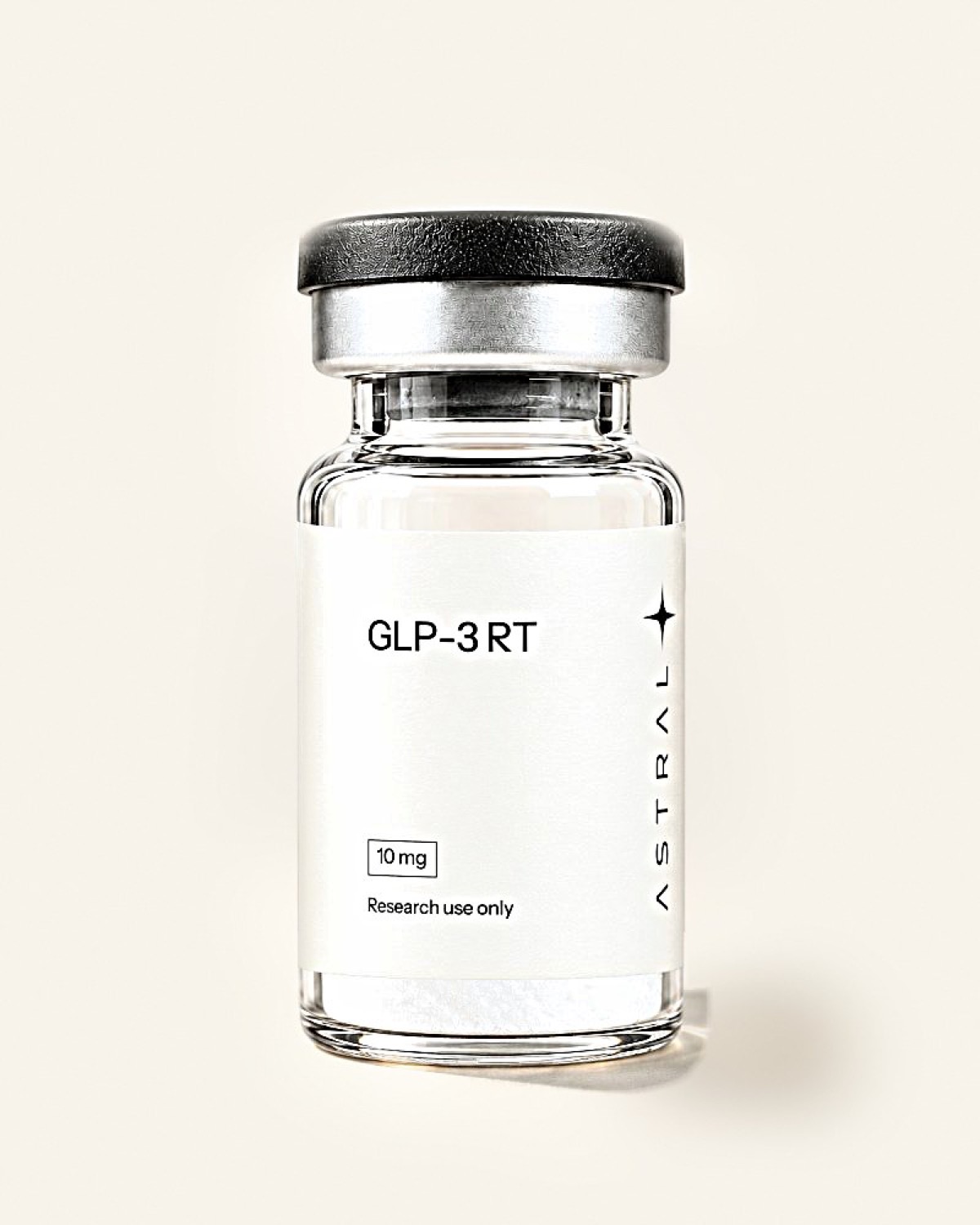
Retatrutide is a synthetic peptide, 39 amino acids long, built to activate three receptors at once: the GIP receptor, the GLP-1 receptor and the glucagon receptor. Eli Lilly developed it under the code LY3437943. Astral lists it as GLP-3 RT, CAS 2381089-83-2, a lyophilized powder in 10, 20 and 30 mg vials, supplied for laboratory research only.
Searchers reach it under several names. Our retatrutide product page abbreviates the third receptor to “Glyc”, the catalog entry says GLP-3 RT, and the primary papers say LY3437943 or retatrutide, so a reader can arrive carrying four different words for one chain. All of them describe the same 39 residues. When a listing or a certificate gives a CAS number, 2381089-83-2 is the one to check it against.
Table of contents
What retatrutide is at the molecular level
Retatrutide is one peptide chain of 39 residues, patterned on the gut-hormone family that includes GIP and GLP-1 and edited so that a single sequence can sit in three different receptor pockets. Its International Nonproprietary Name is retatrutide. The US Adopted Name is the same word, and the FDA’s substance identifier, the UNII, is NOP2Y096GV. Molecular formula C221H342N46O68. The molar mass works out to 4731.4 g/mol, which is the figure on our product page, and PubChem rounds the same computation to 4731.
A few positions carry amino acids that do not occur in natural proteins, alpha-aminoisobutyric acid (Aib) and alpha-methyl-leucine among them, standing in where a natural residue would otherwise sit. The lysine at position 17 carries a fatty diacid chain through a short linker. Semaglutide and tirzepatide are built the same way, each with its chain hung off a lysine at position 20, so the lipidation itself is standard practice in this family and the position is what differs. Bound to a receptor, most of the chain folds into one continuous helix.
Which receptors does retatrutide act on?
The GIP receptor, the GLP-1 receptor and the glucagon receptor. All three are class B1 G protein-coupled receptors, and earlier peptides in this family had reached them one or two at a time.
The clearest look at how one sequence manages all three came in 2024, when a group at the Shanghai Institute of Materia Medica published cryo-EM structures of retatrutide bound to each receptor at 2.68, 3.26 and 2.84 angstrom (Li et al., Cell Discovery). The three structures are hard to tell apart. Residues 1 through 13 of the peptide drop into the transmembrane core of the receptor, residues 14 through 30 lie along the receptor’s extracellular domain, and the three receptor backbones differ from one another by under 1 angstrom. The differences that let one peptide serve three receptors are confined to a few extracellular loops and helix tips. Cell assays from the discovery work, summarized in the same paper’s introduction, put retatrutide at 8.9 times the potency of GIP at the GIP receptor, and below the native hormones at the other two, at roughly 0.3 of glucagon’s potency and 0.4 of GLP-1’s. What that activity pattern does inside a living system is the subject of Lilly’s clinical program, and this page stops at the molecule.
Retatrutide vs tirzepatide and semaglutide
Semaglutide is a GLP-1 receptor agonist. Tirzepatide activates GLP-1 and GIP. Retatrutide adds the glucagon receptor to those two, and the literature calls it a triple agonist or tri-agonist on that basis. Structurally the three are cousins. Lipidated peptides in the 30-to-40-residue range, each with a fatty diacid hung off a lysine. The 2022 paper in Cell Metabolism that first described LY3437943 lays out how the balance of activity across the three receptors was tuned.
For the two side by side, receptor by receptor and status by status, see retatrutide vs tirzepatide.
Is GLP-3 the same as retatrutide?
On this site, yes. GLP-3 RT is our catalog name for retatrutide, with the 3 standing for the three receptors and the RT for the compound. One CAS number sits behind both labels, 2381089-83-2, and PubChem’s depositor records for that CAS carry the names retatrutide, LY3437943 and the INN and USAN entries. A label that says GLP-3, GLP-3 RT, retatrutide or LY3437943 and carries that CAS is describing this molecule, and one carrying a different CAS is describing something else.
How retatrutide is made and supplied
Retatrutide is built by solid-phase peptide synthesis, one residue at a time on a solid support, then purified and freeze-dried. A 2026 paper in Organic Letters that proposes a liquid-phase alternative opens by noting that synthesis of the compound still relies predominantly on the solid-phase route.
Astral supplies GLP-3 RT as that lyophilized powder, in 10 mg, 20 mg and 30 mg vials. A third-party laboratory tests each lot before release, and its certificate is filed on the GLP-3 RT record page of the COA library.
| Item | Value |
|---|---|
| Catalog name | GLP-3 RT |
| Compound | Retatrutide (INN, USAN), developer code LY3437943 |
| Sequence length | 39 amino acids, lipidated at lysine 17 |
| Receptors | GIP, GLP-1 and glucagon receptors |
| CAS | 2381089-83-2 |
| Molecular formula | C221H342N46O68 |
| Molar mass (MW) | 4731.4 g/mol |
| Form | Lyophilized powder |
| Vial sizes | 10 mg, 20 mg, 30 mg |
| Certificates | One per released lot, on the GLP-3 RT certificate page |
Storage and handling
Cold, dry, dark and sealed. A lyophilized vial kept at −20 °C holds for 2 to 5 years or more. A refrigerator at 2 to 8 °C gives 1 to 2 years, a controlled room temperature is good for 6 months or longer, and in every case the vial should come up to room temperature before it is opened, because a cold vial opened early pulls condensation straight onto the powder. The peptide storage guide covers each window and the degradation chemistry behind it.
A vial mixed with Reconstitution Solution, water with 0.9% benzyl alcohol, belongs in the refrigerator and should be used within 28 days. Plain sterile water gives you about a day. Freeze-drying took the water out and held off the degradation reactions with it, and reconstitution puts the water back, so the windows shrink from years to weeks. Run the solvent down the inside of the glass, swirl, never shake, and never refreeze a thawed portion. How to reconstitute peptides has the eight steps.
At 4731.4 g/mol, a 10 mg vial holds 2.11 micromoles, and a solution at 1 mg/mL is 211 micromolar. The peptide calculator does the mg-to-concentration arithmetic for any vial and solvent volume.
Reading the GLP-3 RT label and certificate
The label carries the name and the strength. Purity is on the certificate, and it belongs to the lot, so a 10 mg vial and a 30 mg vial carry different lot codes and different numbers. Released lots follow the pattern AST-RT10-001, with RT10 for the 10 mg format and 001 for the lot sequence, and each code has its own Certificate of Analysis giving purity by HPLC, the date of analysis and the laboratory that ran it. On 2026-10-30 the three released lots stood at 99.09% (AST-RT10-001, ILS Laboratories, analyzed 2026-08-06), 99.61% (AST-RT20-001, Janoshik, 2026-05-11) and 99.751% (AST-RT30-001, Janoshik Analytical, 2026-08-05).
To check your own vial, take the lot code from your paperwork to the GLP-3 RT certificate page and open the PDF filed under it. That puts the purity of your lot on the record. Copy the code into your notebook with the date the vial arrived and, later, the date and concentration of any solution you make from it.
Common questions
Is retatrutide a GLP-1 receptor agonist?
Yes. It is also a GIP receptor agonist and a glucagon receptor agonist, which is why the literature files it as a triple agonist.
What does LY3437943 mean?
It is Eli Lilly’s internal compound code for retatrutide, used in the early papers and trial registrations before the nonproprietary name was assigned. The code and the name refer to the same molecule and the same CAS number.
Has retatrutide been through clinical trials?
Yes. A Lilly-funded phase 2 trial was published in the New England Journal of Medicine in 2023 (ClinicalTrials.gov NCT04881760), and a phase 3 program followed. A review published in October 2026 still describes it as an investigational compound. We do not summarize trial findings here.
How many moles are in a 10 mg vial?
About 2.11 micromoles. Mass in grams, 0.010, divided by molar mass, 4731.4. The peptide calculator converts that to mg/mL and micromolar for whatever volume you add.
How long does lyophilized retatrutide keep?
Years, sealed, dry and dark. The storage guide gives 2 to 5 years or more at −20 °C, 1 to 2 years in a refrigerator and 6 months or longer at a controlled room temperature. The certificate records the purity the lot started with.
Where is the certificate for my lot?
On the GLP-3 RT certificate page, listed by lot code, with the same PDFs linked from the product page.
Astral supplies GLP-3 RT for laboratory research only. This guide describes the molecule, its supply and its handling as research material.
Sources
- Retatrutide, substance record SID 474492335 PubChem, National Library of Medicine
- Structural insights into the triple agonism at GLP-1R, GIPR and GCGR manifested by retatrutide Li W, Zhou Q, Cong Z, et al. Cell Discovery (2024)
- LY3437943, a novel triple glucagon, GIP, and GLP-1 receptor agonist for glycemic control and weight loss: From discovery to clinical proof of concept Coskun T, Urva S, Roell WC, et al. Cell Metabolism (2022)
- A Hydrophobic Tag-Assisted Liquid-Phase Strategy for the Synthesis of Retatrutide Mao CY, Pang ZJ, Qiao GY, et al. Organic Letters (2026)
- Retatrutide as a Unimolecular GIP/GLP-1/Glucagon Receptor Tri-Agonist: Molecular Design, Pharmaceutical Development and Critical Interpretation of Emerging Phase 3 Evidence Mateescu DM, Capraru ID, Enache B, et al. Pharmaceutics (2026)
- Triple-Hormone-Receptor Agonist Retatrutide for Obesity: A Phase 2 Trial Jastreboff AM, Kaplan LM, Frias JP, et al. New England Journal of Medicine (2023)