CJC 1295 Ipamorelin: DAC vs No DAC
CJC-1295, Mod GRF 1-29 and GHRH 1-29 are often treated as interchangeable names, but their structures show where each one begins and ends.
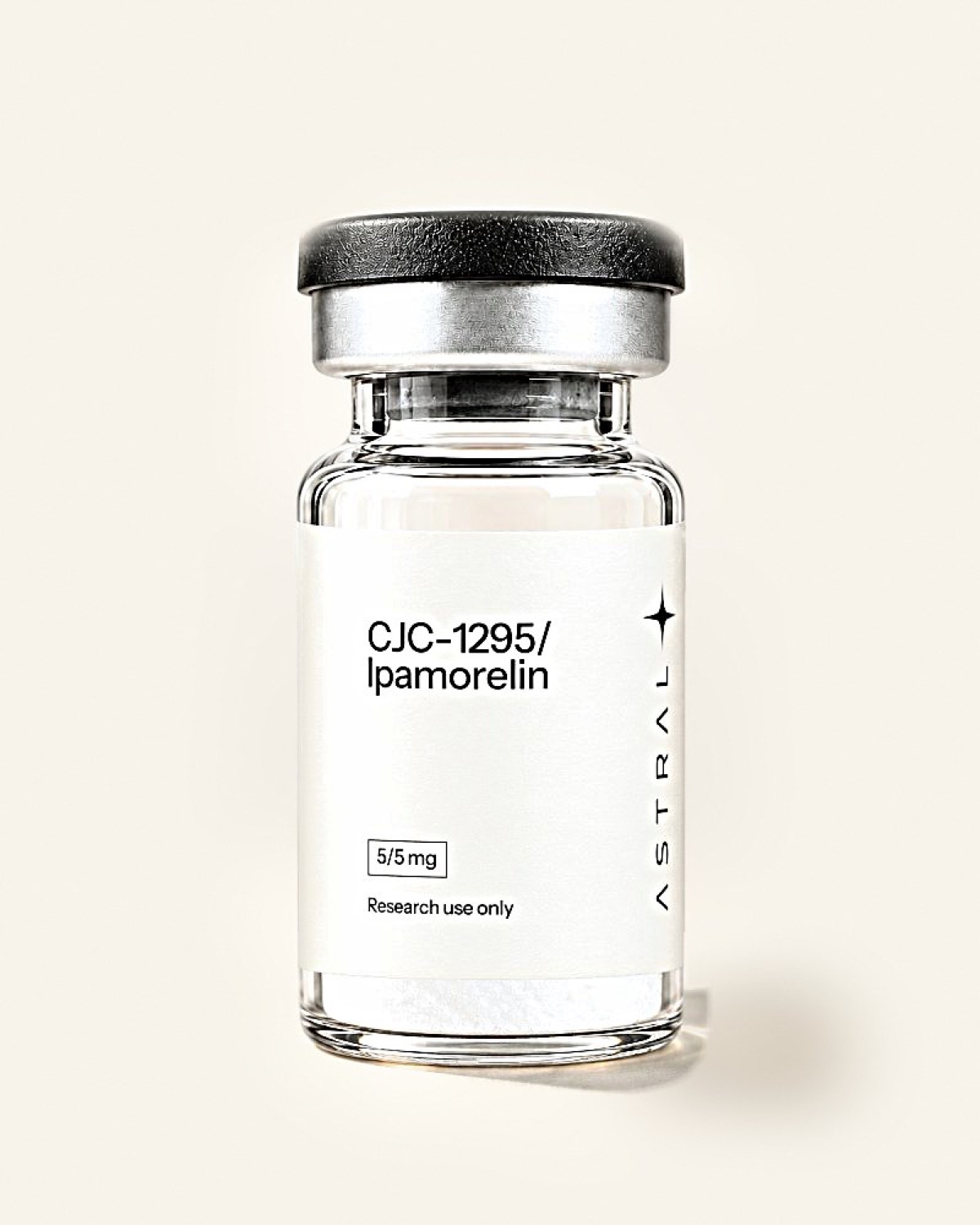
CJC 1295 ipamorelin is a two-peptide blend: a modified 29-residue GHRH fragment and the five-residue peptide ipamorelin. In Astral’s CJC-1295 / Ipamorelin blend, the CJC component is the form commonly called CJC-1295 no DAC or Mod GRF 1-29, rather than the albumin-binding molecule that the original CJC-1295 papers studied.
Those names are easy to collapse into one lineage, but they cover two peptide classes and several GHRH-derived structures. The CJC-1295 / Ipamorelin product record links CAS 863288-34-0 to the plain modified 29-residue chain and CAS 170851-70-4 to ipamorelin. The decoder below starts with sequence, formula and mass because those identifiers are more precise than a vendor name.
Table of contents
What are the identifiers for CJC-1295 and ipamorelin?
Four records settle most of the naming problem. PubChem identifies native-sequence GHRH 1-29 amide as sermorelin, the modified chain without the albumin-binding group as CID 56841945, CJC-1295 with that group as CID 91971820, and ipamorelin as CID 9831659.
| Identity | Other names and codes | Class | Sequence or defining structure | Formula and molar mass | CAS number | PubChem CID |
|---|---|---|---|---|---|---|
| GHRH 1-29 amide | GRF(1-29)-NH2, sermorelin | 29-residue GHRH fragment | Tyr-Ala-Asp-Ala-Ile-Phe-Thr-Asn-Ser-Tyr-Arg-Lys-Val-Leu-Gly-Gln-Leu-Ser-Ala-Arg-Lys-Leu-Leu-Gln-Asp-Ile-Met-Ser-Arg-NH2 | C149H246N44O42<br>3357.9 g/mol | 86168-78-7 | 16132413 |
| Mod GRF 1-29 | Tetrasubstituted GRF 1-29, CJC-1295 no DAC | Modified 29-residue GHRH analog | Tyr-D-Ala-Asp-Ala-Ile-Phe-Thr-Gln-Ser-Tyr-Arg-Lys-Val-Leu-Ala-Gln-Leu-Ser-Ala-Arg-Lys-Leu-Leu-Gln-Asp-Ile-Leu-Ser-Arg-NH2 | C152H252N44O42<br>3367.9 g/mol | 863288-34-0 | 56841945 |
| CJC-1295 with DAC | CJC-1295, CJC-1295 DAC, DAC:GRF | Albumin-binding GHRH analog | Mod GRF 1-29 plus a C-terminal lysine carrying a maleimidopropionamide group | C165H269N47O46<br>3647.2 g/mol | 446262-90-4 | 91971820 |
| Ipamorelin | NNC-26-0161 | Modified pentapeptide secretagogue | Aib-His-D-2-Nal-D-Phe-Lys-NH2 | C38H49N9O5<br>711.9 g/mol | 170851-70-4 | 9831659 |
The values come from the four PubChem records. One caution sits inside CID 56841945 itself: its synonym list contains both “CJC-1295-no DAC” and labels that say “with DAC.” Its displayed structure has 29 residues and no maleimide group, however, and its formula and mass match the no-DAC chain. The structure resolves the contradictory synonyms.
What is GHRH 1-29?
GHRH 1-29 means the first 29 amino acids of the growth hormone-releasing hormone sequence, with the end capped as an amide. PubChem files that 29-residue native-sequence peptide as sermorelin, CID 16132413. Its sequence contains Asn at position 8, Gly at 15 and Met at 27.
Those three positions matter because they make the difference visible when GHRH 1-29 is placed beside Mod GRF 1-29. The “1-29” part describes the length and source segment. It does not say whether the sequence has been modified.
What is Mod GRF 1-29?
Mod GRF 1-29 is a tetrasubstituted version of GHRH 1-29. Its four changes are D-Ala at position 2, Gln at 8, Ala at 15 and Leu at 27. The other 25 residues stay in the same order, and the chain still ends in Arg-NH2.
That chain is the material commonly sold as CJC-1295 no DAC. PubChem CID 56841945 gives it formula C152H252N44O42 and a molar mass of 3367.9 g/mol. Astral’s product page prints CAS 863288-34-0 and 3367.97 g/mol for the CJC half of the blend, which is consistent with the PubChem record after rounding.
“No DAC” therefore points to a complete 29-residue molecule with its own identifiers. It is not a batch of CJC-1295 from which a detachable ingredient has been removed. The phrase tells a reader that the C-terminal albumin-binding unit found on the original research compound is absent.
CJC 1295 DAC vs no DAC: what is the difference?
In the original literature, CJC-1295 carried DAC. The acronym means drug affinity complex. Here it was a maleimidopropionamide-lysine unit added at the C terminus of the modified GRF chain. The maleimide was designed to react with the free thiol on cysteine 34 of serum albumin, creating a covalent bioconjugate after the peptide entered circulation. That chemistry, rather than the four substitutions alone, defined the long-acting research molecule in the 2005 paper. (Jetté et al., 2005)
The structural record shows the addition. CJC-1295 with DAC is C165H269N47O46 at 3647.2 g/mol, CID 91971820. The no-DAC 29-mer is C152H252N44O42 at 3367.9 g/mol, CID 56841945. Different formula, different mass, different structure.
FDA reviewers described the same naming fault in 2024. Their compounding review separated CJC-1295 free base from CJC-1295 DAC free base as distinct active moieties and said common names made the intended structure unclear. The FDA slide deck identified DAC as the C-terminal maleimidopropionamide-lysine unit. (FDA CJC-1295 review)
The cleanest convention is to reserve CJC-1295 for the DAC-bearing molecule when discussing the published development program, then write Mod GRF 1-29 or CJC-1295 no DAC for the plain 29-residue chain. A source that prints only “CJC-1295” has not supplied enough information. Check CID, formula, mass, sequence and CAS.
What is ipamorelin?
Ipamorelin is a modified pentapeptide, five residues long. Its sequence is Aib-His-D-2-Nal-D-Phe-Lys-NH2, and PubChem records formula C38H49N9O5, molar mass 711.9 g/mol and CAS 170851-70-4. Aib and D-2-Nal are nonstandard residues, while D-Phe is the D configuration of phenylalanine.
It is not a GHRH fragment and it is not part of the CJC sequence. The 1998 discovery paper classified it as a growth hormone secretagogue and reported that it had emerged from a chemistry program that removed the central Ala-Trp pair from an earlier peptide series. The researchers studied it in primary rat pituitary cells, anesthetized rats and conscious swine, and described it as a pentapeptide throughout. (Raun et al., 1998)
That separate lineage explains why a CJC-1295 / ipamorelin blend needs two CAS numbers and two molecular weights. The slash joins two constituents in one product name. It does not name one larger peptide.
What did CJC-1295 and ipamorelin research study?
The 2005 CJC-1295 paper synthesized three maleimide-bearing hGRF 1-29 derivatives, conjugated them to human serum albumin outside the body, and tested them in cultured rat pituitary cells and male rats. The authors selected CJC-1295, described its C-terminal maleimidopropionamide-lysine addition, and detected an albumin-associated form in rat plasma. (Jetté et al., 2005)
A 2006 paper then reported two randomized, placebo-controlled studies of the long-acting CJC-1295 compound in healthy adults. The abstract called it a long-acting GHRH analog and did not describe a no-DAC material. That study belongs to the DAC-bearing development history, so it should not be cited as if CID 56841945 were the tested molecule. (Teichman et al., 2006)
Ipamorelin’s 1998 paper was preclinical, using cell, rat and swine models. Later, a multicenter phase 2 trial studied ipamorelin after bowel resection. It enrolled 117 participants, and its key endpoint was time from the start of study treatment to tolerance of a standardized solid meal. The reported comparison did not reach statistical significance at p = 0.15, and the authors reported no significant differences in the key or secondary efficacy analyses. (Beck et al., 2014)
Are CJC-1295 and ipamorelin FDA-approved?
No FDA-approved product appears in the agency’s drug database under either generic name. FDA’s current compounding-risk page lists CJC-1295 among withdrawn bulk-substance nominations and lists ipamorelin acetate in category 2 under the 503B interim policy.
The agency’s exact wording is narrower than a general statement about all material. For compounded CJC-1295, the page says products “may pose risk for immunogenicity.” For ipamorelin acetate, it says the substance “also contains unnatural amino acids.” The same entries discuss peptide-related impurities, characterization and limited safety information. (FDA bulk-substance risk page)
How can you decode a CJC-1295 / ipamorelin label?
Start with the CJC side. A formula of C152H252N44O42, mass near 3367.9 g/mol and CID 56841945 identify Mod GRF 1-29 without DAC. A formula of C165H269N47O46, mass near 3647.2 g/mol and CID 91971820 identify the DAC-bearing compound from the original CJC papers.
Then check the second constituent. Ipamorelin is CID 9831659, CAS 170851-70-4 and 711.9 g/mol. On Astral’s CJC-1295 / Ipamorelin page, the pair is the no-DAC 29-mer plus ipamorelin, freeze-dried together in equal 5 mg amounts. Identity settled, the separate peptide storage guide covers bench storage without turning a chemical name into a handling guess.
For another GHRH-derived name that is often placed beside CJC-1295, see what tesamorelin is. Its structure and development record belong to a separate guide.
Common questions
What is CJC 1295?
In the original papers, CJC-1295 was a modified GHRH 1-29 analog with a C-terminal drug affinity complex that bound albumin. Some suppliers now use the name for Mod GRF 1-29 without that group, so the formula, mass or PubChem CID is needed to identify the molecule.
Is CJC 1295 no DAC the same as Mod GRF 1-29?
That is the common market usage. Both names point to the tetrasubstituted 29-residue chain, C152H252N44O42, without the C-terminal maleimidopropionamide-lysine unit.
What is the difference between CJC 1295 DAC vs no DAC?
The DAC version has a C-terminal drug affinity complex and is PubChem CID 91971820 at 3647.2 g/mol. The no-DAC version is the plain modified 29-residue chain, CID 56841945 at 3367.9 g/mol.
What is Mod GRF 1-29?
Mod GRF 1-29 is GHRH 1-29 with four substitutions: D-Ala2, Gln8, Ala15 and Leu27. It ends in Arg-NH2 and contains no albumin-binding maleimide group.
What is ipamorelin?
Ipamorelin is a modified pentapeptide with the sequence Aib-His-D-2-Nal-D-Phe-Lys-NH2. It is a separate secretagogue-class molecule, not a GHRH fragment or part of the CJC chain.
Is ipamorelin the DAC in CJC-1295?
No. DAC is the C-terminal maleimidopropionamide-lysine unit on the albumin-binding form of CJC-1295. Ipamorelin is a separate five-residue peptide with its own CAS number and PubChem record.
Sources
- Sermorelin, compound summary (CID 16132413) PubChem, National Library of Medicine
- Modified GRF 1-29, compound summary (CID 56841945) PubChem, National Library of Medicine
- CJC-1295, compound summary (CID 91971820) PubChem, National Library of Medicine
- Ipamorelin, compound summary (CID 9831659) PubChem, National Library of Medicine
- Jetté L, Léger R, Thibaudeau K, et al Human growth hormone-releasing factor 1-29 albumin bioconjugates and the identification of CJC-1295. Endocrinology (2005)
- Teichman SL, Neale A, Lawrence B, et al Prolonged stimulation by CJC-1295, a long-acting analog of growth hormone-releasing hormone. Journal of Clinical Endocrinology & Metabolism (2006)
- Raun K, Hansen BS, Johansen NL, et al Ipamorelin, the first selective growth hormone secretagogue. European Journal of Endocrinology (1998)
- Beck DE, Sweeney WB, McCarter MD Phase 2 study of ipamorelin after bowel resection. International Journal of Colorectal Disease (2014)
- CJC-1295-related bulk drug substances: chemistry, nomenclature and regulatory review U.S. Food and Drug Administration (2024)
- Certain bulk drug substances for use in compounding that may present significant safety risks U.S. Food and Drug Administration