DSIP Peptide: What Is Delta Sleep-Inducing Peptide?
What DSIP is, where its nine-residue sequence came from, and why nobody has yet found the gene or the receptor behind it.
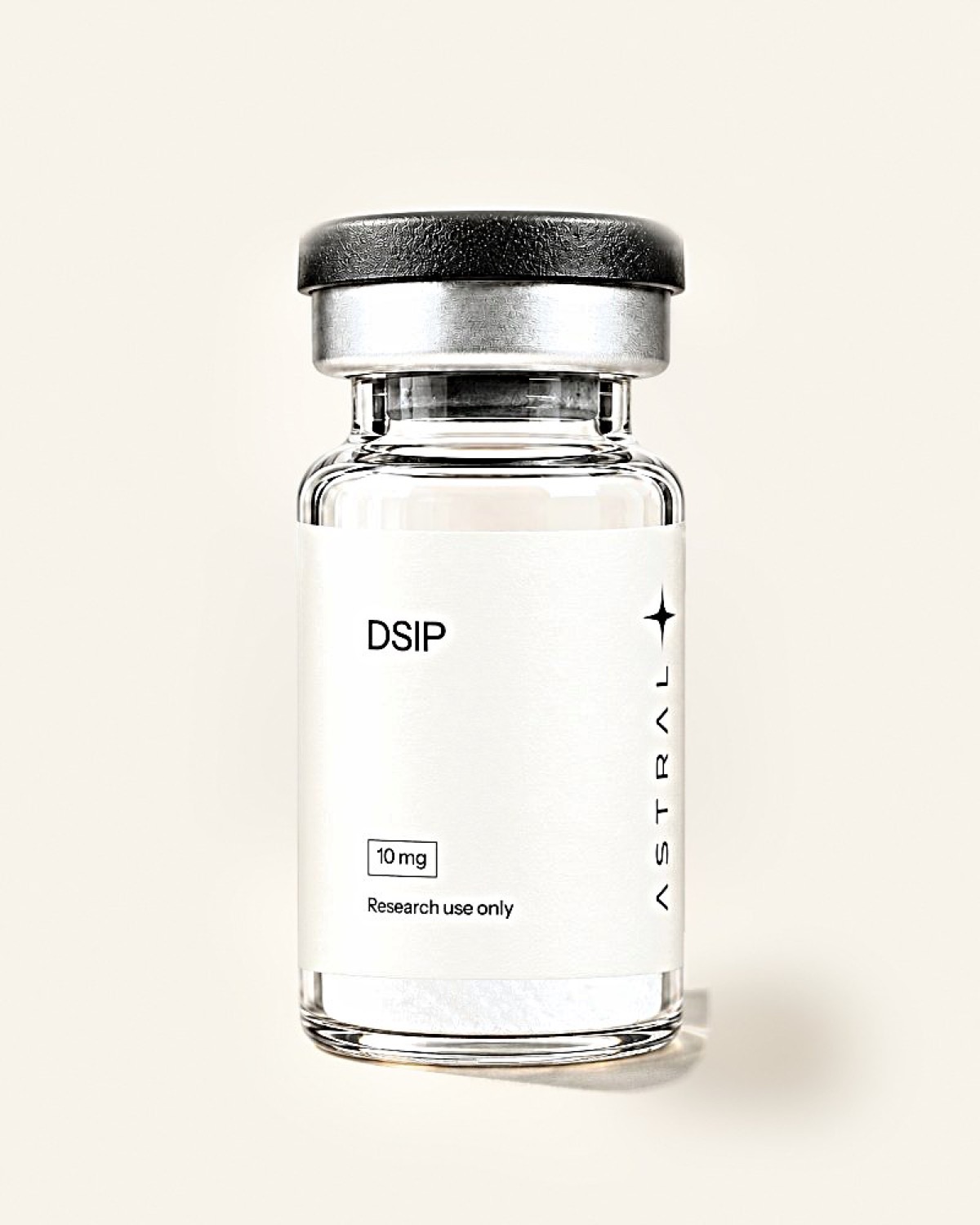
The DSIP peptide is a chain of nine amino acids, Trp-Ala-Gly-Gly-Asp-Ala-Ser-Gly-Glu, first isolated from the blood of sleeping rabbits and published in 1977 by a group in Basel. DSIP stands for delta sleep-inducing peptide, after the slow delta waves it produced on rabbit brain recordings. Almost fifty years on, no gene, precursor protein or receptor for it has been identified, so its place in biology is still an open question.
Astral lists DSIP as a freeze-dried powder in a 10 mg vial, CAS 62568-57-4. This guide covers what the molecule is, how it was found, what the sequence looks like on paper, and why the papers written about it disagree with each other.
Table of contents
What is DSIP?
DSIP is a nonapeptide, meaning nine amino acids joined in a single unbranched chain. Its formal name under the World Health Organization naming system is emideltide. All nine residues are ordinary amino acids of the kind found in any protein, with free ends and no unusual building blocks. That sets it apart from a designed peptide such as SS-31, which carries a D-amino acid, a methylated tyrosine and an amide cap, as covered in What is SS-31.
The name describes the first experiment, and that is all it describes. “Delta” refers to delta waves, the slow, high-amplitude pattern an electroencephalogram (EEG) records during deep sleep. The peptide was named for raising that pattern in rabbits. Whether it has anything to do with sleep in an intact animal is the part that never got settled.
What is the DSIP sequence?
The DSIP sequence is Trp-Ala-Gly-Gly-Asp-Ala-Ser-Gly-Glu, written WAGGDASGE in one-letter code. It reads tryptophan, alanine, glycine, glycine, aspartic acid, alanine, serine, glycine, glutamic acid. That is the sequence the Basel group published in 1977, and it is the one on file at UniProt and PubChem today.
| Item | Value |
|---|---|
| Full name | Delta sleep-inducing peptide |
| Other names | DSIP, emideltide (INN), DSIP nonapeptide |
| Class | Linear nonapeptide, 9 amino acids |
| Sequence | Trp-Ala-Gly-Gly-Asp-Ala-Ser-Gly-Glu (WAGGDASGE) |
| Molecular formula | C35H48N10O15 |
| Molar mass | 848.8 g/mol |
| CAS number | 62568-57-4 |
| PubChem CID | 68816 |
| UniProt | P01158 (rabbit) |
| Form | Lyophilized powder |
| Astral vial size | 10 mg |
A few things stand out in those nine letters. Three of the nine are glycine, the smallest amino acid, so the chain is flexible. Two are acidic, the aspartic acid at position 5 and the glutamic acid at the end, and none is basic, so the peptide carries a net negative charge in neutral solution. The single tryptophan at position 1 is the only ring-bearing residue, and it is the reason the powder is worth keeping out of the light.
A second registry number, 69431-45-4, is also in circulation. PubChem files both numbers under the same compound record, so they point to one molecule, and 62568-57-4 is the one on the Astral product page.
Where did DSIP come from?
DSIP came out of a long experiment on whether sleep could be passed from one animal to another through the blood. M. Monnier’s group in Basel kept donor rabbits asleep by electrically stimulating the thalamus, a relay region deep in the brain. They filtered the blood draining from the brain through a dialysis membrane and infused the filtrate into the brain ventricles of recipient rabbits. From 1963 to 1970 that work established that something in the filtrate raised delta activity in the recipients.
It took another seven years to find out what. Between 1970 and 1977, G. A. Schoenenberger and Monnier isolated the active material, worked out its amino acid sequence, and made it from scratch. Their 1977 paper in the Proceedings of the National Academy of Sciences gave the sequence and reported a test of the synthetic peptide alongside eight relatives: five fragments, two nonapeptides with residues swapped, and a related tripeptide. All nine went into the brain ventricles of rabbits under double-blind conditions, 58 animals in total. Only the full synthetic DSIP raised delta and spindle activity on the EEG.
A follow-up in 1978 added a detail that matters to anyone who handles the powder. Only the peptide with a normal alpha-linked aspartic acid at position 5 was highly active. The isomer in which that aspartic acid is joined through its side chain, a beta-aspartyl peptide of identical mass and formula, was not.
Was DSIP discovered in 1974 or 1977?
The primary record supports 1977. Some pages give 1974, and others give only the full span from 1963. The sequence appears in the Basel group’s 1977 paper in the Proceedings of the National Academy of Sciences, and UniProt cites the 1977 and 1978 papers as the source of the sequence. Schoenenberger’s own 1984 account dates the isolation and synthesis to the years 1970 to 1977. A reader who wants one date for the molecule as a defined chemical should use 1977.
Why is DSIP’s biology still disputed?
Because the usual proof that a peptide is made by the body was never completed. A natural peptide is normally traced to a gene, a larger precursor protein it is cut from, and a receptor it binds. For DSIP none of the three has been found. A 2006 review in the Journal of Neurochemistry, titled “a still unresolved riddle”, put it plainly: the link between DSIP and sleep was never characterized further, in part because the gene, the protein and any receptor were never isolated. A 2011 paper from Moscow said the same about its origin and proposed that a family of histone demethylase proteins, which contain a stretch differing from DSIP at two positions, might be the source of peptides with DSIP-like activity. That remains a proposal.
Four separate problems sit under the dispute.
The antibody evidence is ambiguous. Much of the case for DSIP in brain, plasma and other tissues rests on antibodies, which report “DSIP-like immunoreactivity” and not the nonapeptide itself. In 1993 a Karolinska Institute group purified one of the large immunoreactive forms from pig brain. It was a 77-residue peptide recognized by an antiserum raised against synthetic DSIP, and its amino acid sequence was unrelated to DSIP.
The sleep results did not hold up cleanly. A 1984 review reported mainly delta-sleep effects in rabbits, rats and mice, a more pronounced effect on REM sleep in cats, and a U-shaped activity curve. The 2006 review went further and stated that certain artificial analogs of DSIP promoted slow-wave sleep in rabbits and rats in the authors’ own experiments, while DSIP itself did not.
The human trials disagreed. A 1987 double-blind study in 14 people with chronic insomnia reported improved night sleep. A 1992 double-blind study in 16 people with chronic insomnia found weak effects that could in part be explained by a chance change in the placebo group, and its authors concluded that short-term treatment was unlikely to be of major benefit.
The peptide does not last in biological fluids. A 1984 study using an enzyme immunoassay measured a mean plasma half-life of about 4 minutes after intravenous injection in dogs, and shorter in rats. In rat brain homogenate, enzymes clipped the tryptophan from the front of the chain within minutes.
So the fair summary has two halves. The chemistry is settled: nine residues, one sequence, one mass. The biology is not, and a page that calls DSIP a hormone made in the hypothalamus is stating as fact something the literature has left open.
Is DSIP a naturally occurring peptide?
It was isolated from an animal, which is why many pages call it naturally occurring, and one of the 1977 papers used that phrase in its title. The stricter test is whether the body has a gene that codes for it, and by that test the question is open. UniProt holds an entry for rabbit DSIP based on direct sequencing of the peptide, with no gene attached. The peptide has been made by chemical synthesis since the 1977 work, and the synthetic version is the one the original activity tests were run on.
Is DSIP FDA-approved?
No. The FDA’s database of approved drug products has no entry for emideltide, and no drug containing it has been approved in the United States. The agency does name it in its compounding materials. Emideltide (DSIP) appears on the FDA’s list of bulk drug substances that were placed in category 2, the group flagged for potential significant safety risks in compounding, and were later withdrawn by the parties who nominated them. The FDA’s stated concerns there are the risk of immunogenicity, the difficulty of characterizing peptide-related impurities, and a lack of safety information.
How does DSIP compare with Selank and Semax?
All three are short peptides in the Astral catalog, and the difference is in where each sequence came from. Selank and Semax are seven-residue peptides designed in a Moscow laboratory, each built from a fragment of a known protein with a Pro-Gly-Pro tail added. DSIP was found, not designed. Its sequence was read off material purified from rabbit blood, and its parent protein, if it has one, is unknown.
| DSIP | Selank | Semax | |
|---|---|---|---|
| Length | 9 amino acids | 7 amino acids | 7 amino acids |
| Sequence | WAGGDASGE | TKPRPGP | MEHFPGP |
| Origin | Isolated from rabbit blood, 1977 | Designed from tuftsin | Designed from ACTH(4-7) |
| Known parent protein | None identified | Immunoglobulin G | ACTH |
| Molar mass | 848.8 g/mol | 751.9 g/mol | 813.9 g/mol |
| Astral vial size | 10 mg | 10 mg | 10 mg |
The longer comparison of those two is in Selank vs Semax.
How is DSIP handled at the bench?
Like any freeze-dried peptide, with one extra note for the tryptophan. Keep the sealed vial cold, dry and dark, and let a cold vial reach room temperature before you open it so condensation does not land on the powder. Ultraviolet light can oxidize tryptophan, and DSIP begins with one, so a carton or a drawer is the right place for it. The windows for freezer, refrigerator and shelf are in the peptide storage guide.
At 848.8 g/mol, a 10 mg vial holds about 11.8 micromoles, and a 1 mg/mL solution is about 1.18 millimolar. Once mixed with Reconstitution Solution, the vial belongs in the refrigerator at 2 to 8 °C. The peptide calculator converts any vial and volume to mg/mL, and How to reconstitute peptides has the steps.
One more point from the 1978 paper: the beta-aspartyl isomer has the same formula and mass as DSIP, so a mass reading alone cannot tell the two apart. DSIP is in the Astral catalog in the 10 mg size.
Common questions
What is DSIP?
DSIP is delta sleep-inducing peptide, a nine-amino-acid peptide with the sequence Trp-Ala-Gly-Gly-Asp-Ala-Ser-Gly-Glu. It was isolated from rabbit blood by a Basel research group and its sequence was published in 1977.
What does DSIP stand for?
Delta sleep-inducing peptide. The name comes from the delta waves, a slow EEG pattern, that rose in rabbits given the peptide in the original 1977 experiments.
What is the DSIP sequence?
Trp-Ala-Gly-Gly-Asp-Ala-Ser-Gly-Glu, or WAGGDASGE in one-letter code. The molecular formula is C35H48N10O15 and the molar mass is 848.8 g/mol.
Is DSIP the same as emideltide?
Yes. Emideltide is the international nonproprietary name for the same nonapeptide, and it is the name the FDA uses for it.
Is DSIP a natural peptide?
It was first isolated from rabbit blood, but no gene, precursor protein or receptor for it has been identified, so how or whether the body makes it remains unresolved. A synthetic version has existed since 1977.
How many micromoles are in a 10 mg vial of DSIP?
About 11.8. That is 0.010 grams divided by the molar mass, 848.8 g/mol.
Sources
- Schoenenberger GA, Monnier M Characterization of a delta-electroencephalogram (-sleep)-inducing peptide. Proceedings of the National Academy of Sciences (1977)
- Schoenenberger GA, Maier PF, Tobler HJ, Wilson K, Monnier M The delta EEG (sleep)-inducing peptide (DSIP). XI. Amino-acid analysis, sequence, synthesis and activity of the nonapeptide. Pflügers Archiv (1978)
- Schoenenberger GA Characterization, properties and multivariate functions of delta-sleep-inducing peptide (DSIP). European Neurology (1984)
- Graf MV, Kastin AJ Delta-sleep-inducing peptide (DSIP): a review. Neuroscience and Biobehavioral Reviews (1984)
- Kovalzon VM, Strekalova TV Delta sleep-inducing peptide (DSIP): a still unresolved riddle. Journal of Neurochemistry (2006)
- Mikhaleva II, Prudchenko IA, Ivanov VT, Voitenkov VB JmjC-domain-containing histone demethylases of the JMJD1B type as putative precursors of endogenous DSIP. Peptides (2011)
- Sillard R, Schulz-Knappe P, Vogel P, et al A novel 77-residue peptide from porcine brain contains a leucine-zipper motif and is recognized by an antiserum to delta-sleep-inducing peptide. European Journal of Biochemistry (1993)
- Schneider-Helmert D Effects of delta-sleep-inducing peptide on 24-hour sleep-wake behaviour in severe chronic insomnia. European Neurology (1987)
- Bes F, Hofman W, Schuur J, Van Boxtel C Effects of delta sleep-inducing peptide on sleep of chronic insomniac patients. A double-blind study. Neuropsychobiology (1992)
- Kato N, Honda Y, Ebihara S, Naruse H, Takahashi Y Development of an enzyme immunoassay for delta sleep-inducing peptide (DSIP) and its use in the determination of the metabolic clearance rate of DSIP administered to dogs. Neuroendocrinology (1984)
- Huang JT, Lajtha A The degradation of a nonapeptide, sleep inducing peptide, in rat brain: comparison with enkephalin breakdown. Research Communications in Chemical Pathology and Pharmacology (1978)
- Delta sleep-inducing peptide, compound summary CID 68816. PubChem, National Library of Medicine (2026)
- Delta sleep-inducing peptide, rabbit P01158. UniProt (2026)
- Certain Bulk Drug Substances for Use in Compounding that May Present Significant Safety Risks U.S. Food and Drug Administration (2026)