NAD+ Peptide: Is NAD+ Actually a Peptide?
NAD+ sits in peptide catalogs, ours included, yet it holds no amino acids at all. Here is what the molecule is and how to check any compound the same way.
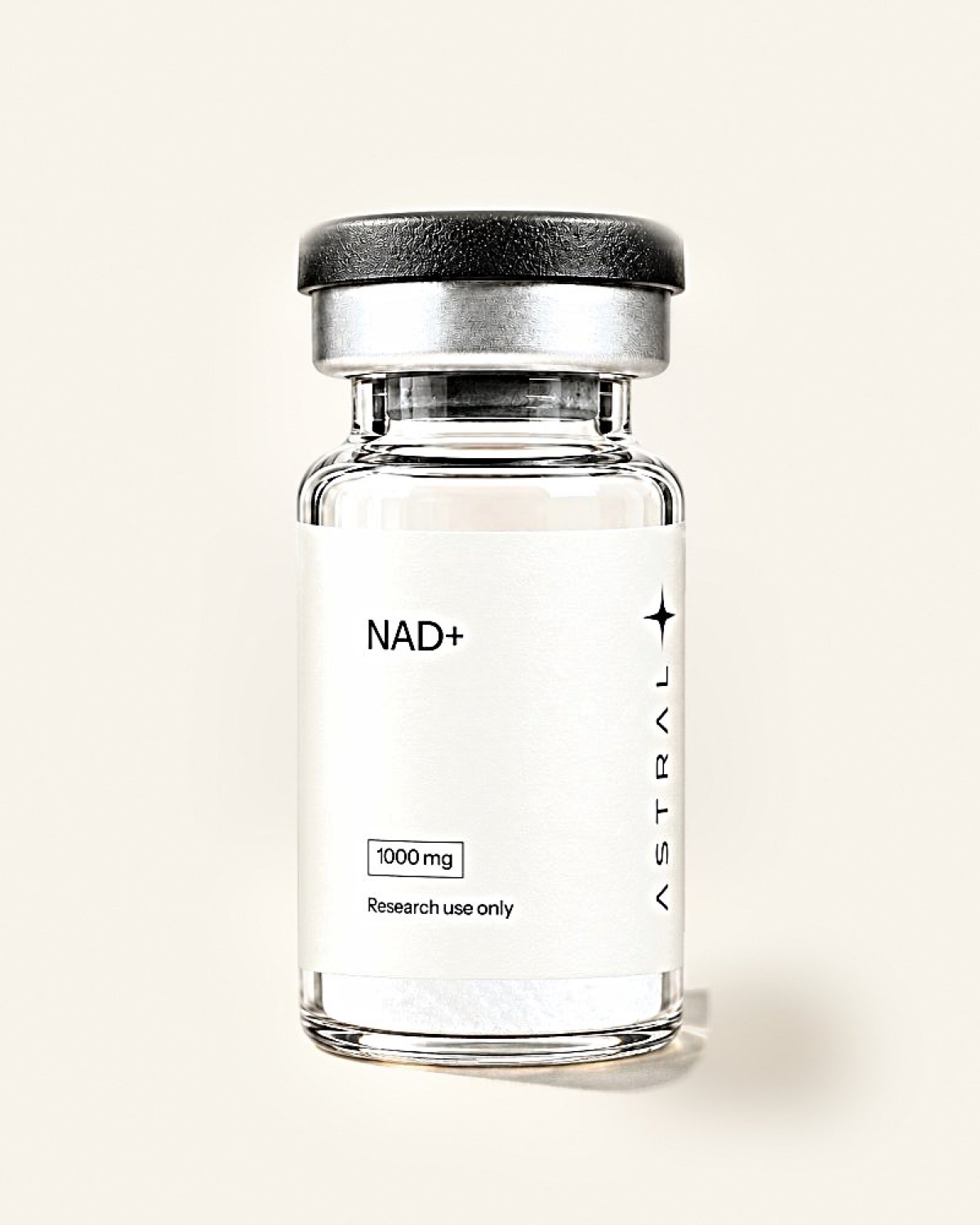
No. The phrase “NAD+ peptide” shows up in catalogs and search boxes, but NAD+ is a dinucleotide coenzyme, two nucleotides joined through their phosphate groups. A peptide is a chain of amino acids held together by amide bonds, and NAD+ contains no amino acids.
The label sticks because NAD+ is sold the same way peptides are, as a freeze-dried powder in a sealed vial, and it comes up in the same searches as mitochondrial peptides such as MOTS-c and SS-31. Astral lists NAD+ in a 1000 mg vial and describes it as a redox coenzyme. Below is what the molecule is, how NAD+ differs from NADH, and a three-question test that sorts any compound into peptide or non-peptide.
Table of contents
What is NAD+?
NAD+ is the oxidized form of nicotinamide adenine dinucleotide, a coenzyme found in all living cells. The full name describes the parts. One half is a nucleotide carrying the base adenine. The other half is a nucleotide carrying nicotinamide, a small ring compound that chemists class as a pyridinecarboxamide. The two halves are joined through their 5’-phosphate groups, which is where the word dinucleotide comes from.
| Item | Value |
|---|---|
| Full name | Nicotinamide adenine dinucleotide, oxidized form |
| Other names and codes | NAD, β-NAD, nadide (the international nonproprietary name), coenzyme I, cozymase, diphosphopyridine nucleotide (DPN) |
| Class | Dinucleotide coenzyme |
| Sequence | None. NAD+ has no amino acids |
| Structure | A nicotinamide nucleotide and an adenine nucleotide joined through their 5’-phosphate groups |
| Molecular formula | C21H27N7O14P2 |
| Molar mass | 663.4 g/mol |
| CAS number | 53-84-9 |
| PubChem CID | 5892 |
| Reduced partner | NADH, C21H29N7O14P2, 665.4 g/mol, CAS 58-68-4 |
Two formulas circulate for NAD+, and both are correct. PubChem’s main record, CID 5892, gives C21H27N7O14P2 at 663.4 g/mol. That is the inner-salt form, where the positive charge on the nicotinamide ring is balanced by a negative charge on one phosphate. ChEBI’s entry for NAD+ counts one more hydrogen and writes C21H28N7O14P2 with a charge of +1, mass 664.4. They describe the same compound at two protonation states. Astral’s product page uses the first, with CAS 53-84-9.
Older papers call the molecule DPN, coenzyme I or cozymase. If an older enzymology paper mentions DPN and DPNH, those are NAD+ and NADH.
Is NAD+ a peptide or a coenzyme?
A coenzyme. The definition of a peptide is narrow enough to settle it. The IUPAC-IUB nomenclature defines a peptide as “any compound produced by amide formation between a carboxyl group of one amino acid and an amino group of another.” Every peptide in a catalog fits that sentence. KPV is three amino acids. SS-31 is four. MOTS-c is sixteen.
NAD+ has none. Its building blocks are two sugars (ribose), two phosphates, adenine and nicotinamide, and the link between the two halves is a phosphate-to-phosphate bond. There is one detail that can mislead a careful reader. The nicotinamide ring carries a carboxamide group, the “amide” in nicotinamide, so the structure does contain an amide. That group hangs off a single ring and joins nothing to anything, which means there is no peptide bond in the molecule.
Why is NAD+ sold beside peptides?
Mostly for practical reasons. NAD+ is supplied the way peptides are, as a lyophilized powder in a vial that is reconstituted before use, and its concentration is worked out with the same arithmetic.
The search overlap does the rest. NAD+, MOTS-c and SS-31 all turn up in mitochondria research, so they get compared with each other even though they are three different kinds of thing. Our guide to what SS-31 is sets the three side by side.
Catalog shorthand follows the shelf, and “peptide” becomes the word for anything that ships as a freeze-dried vial. That is a habit of the trade and carries no chemical meaning. The same question, what counts as a peptide and what does not, comes up with small molecules in SARMs vs peptides.
How do you tell a peptide from a non-peptide?
Ask three questions of the structure. Is it built from amino acids? Are those amino acids joined to each other by amide bonds? Can it be written as a sequence, one letter or three letters per residue? A peptide answers yes to all three.
| Compound | Built from | Bond that holds it together | Peptide? |
|---|---|---|---|
| NAD+ | Two nucleotides (adenine and nicotinamide) | Phosphate to phosphate | No |
| Glutathione | 3 amino acids: glutamic acid, cysteine, glycine | Amide bonds | Yes, a tripeptide |
| KPV | 3 amino acids: lysine, proline, valine | Amide bonds | Yes, a tripeptide |
| SS-31 | 4 amino acids, two of them modified | Amide bonds | Yes, a tetrapeptide |
| MOTS-c | 16 amino acids | Amide bonds | Yes |
Glutathione is the useful contrast, because the same question gets asked about it and the answer goes the other way. Glutathione is three amino acids, with glutamic acid attached through its side chain instead of the usual position, and the IUPAC-IUB definition covers that kind of link by name. Glutathione is listed in the catalog as a peptide, and it is one. The details are in Is glutathione a peptide?.
A quick check that works on any product page: look for a sequence. A peptide has one. NAD+ has a formula and a CAS number, and nothing that could be spelled out in amino acid letters.
NAD+ vs NADH: what is the difference?
NAD+ is the oxidized form and NADH is the reduced form of the same coenzyme. NAD+ accepts a hydride ion, a hydrogen carrying two electrons, and becomes NADH. NADH hands those electrons on and returns to NAD+. A 2021 review in Nature Reviews Molecular Cell Biology described NAD+ as “first identified for its role in regulating metabolic rates in yeast extracts and later as the major hydride acceptor in redox reactions.”
The plus sign marks a positive charge on the nitrogen of the nicotinamide ring. When the hydride arrives, that ring changes from a pyridine to a dihydropyridine, the charge is gone, and the name loses its plus.
| NAD+ | NADH | |
|---|---|---|
| State | Oxidized | Reduced |
| Molecular formula | C21H27N7O14P2 | C21H29N7O14P2 |
| Molar mass | 663.4 g/mol | 665.4 g/mol |
| CAS number | 53-84-9 | 58-68-4 |
| Absorbs UV light at | 260 nm | 260 nm and 340 nm |
| Breaks down faster in | Basic solution | Acidic solution |
The UV row is how a bench tells them apart. NADH absorbs strongly at 340 nm and NAD+ does not, so a spectrophotometer set to 340 nm reads the reduced form alone. The 2024 stability study cited below tracked NADH that way.
The two are separate compounds with separate CAS numbers. An order for NAD+ is an order for the oxidized form, and Astral’s vial is NAD+, CAS 53-84-9.
Who discovered NAD+?
The first trace of it came from yeast. Arthur Harden passed yeast extract through a very fine filter and found that fermentation needed two things, in the words of the Nobel Foundation “the real enzyme and a coenzyme.” Hans von Euler-Chelpin and his associates worked out more of the process in the 1910s and 1920s, and the two men shared the 1929 Nobel Prize in Chemistry.
Later work showed the coenzyme was more than a carrier of electrons. A 2007 review in Trends in Biochemical Sciences summed up NAD+ as “both a coenzyme for hydride-transfer enzymes and a substrate for NAD+-consuming enzymes,” a group that includes poly(ADP-ribose) polymerases and sirtuins. Those enzymes use NAD+ up instead of handing it back unchanged.
Is NAD+ FDA-approved?
No FDA-approved drug lists NAD+ as an active ingredient. A search of the FDA’s approved-drug database on November 13, 2026 returned no product under nadide or nicotinamide adenine dinucleotide. The FDA does list “Nicotinamide Adenine Dinucleotide (NAD)” among the bulk substances under evaluation for pharmacy compounding, Category 1 of its 503A list as updated May 14, 2026. Under evaluation means the agency has not finished its review.
How should NAD+ be handled at the bench?
Astral supplies NAD+ as a lyophilized powder, 1000 mg per vial. The general rules for a freeze-dried vial apply: sealed, cold, dry and dark until use, and brought to room temperature before opening. Our peptide storage guide covers those habits, though its time windows were written for peptides.
In solution NAD+ has its own chemistry. The oxidized form breaks down by a base-catalyzed route at high pH, and the reduced form, NADH, breaks down by an acid-catalyzed route at low pH. Buffer choice matters as well. A 2024 study in Molecules tracked both forms at pH 8.5 for 43 days at 19 and 25 °C and found them most stable in Tris buffer, while 2 mM NAD+ in HEPES degraded almost entirely over the same period. Temperature mattered too, with a six-degree rise roughly tripling the NADH loss rate in Tris.
For the arithmetic, 1000 mg at 663.4 g/mol is about 1.51 millimoles. The peptide calculator converts a vial and a volume to mg/mL for any compound, peptide or otherwise, and the mixing steps are in How to reconstitute peptides. Batch purity is on the certificate published with each lot.
The current vial is in the catalog at NAD+.
Common questions
Is NAD a peptide?
No. NAD is nicotinamide adenine dinucleotide, a coenzyme made of two nucleotides joined through their phosphate groups. It contains no amino acids, and a peptide is by definition a chain of amino acids.
Is NAD+ a peptide or a protein?
Neither. Peptides and proteins are both chains of amino acids, and NAD+ has none. It is a dinucleotide with the formula C21H27N7O14P2 and a molar mass of 663.4 g/mol.
What is NAD+ made of?
Two nucleotides. One carries adenine and the other carries nicotinamide, and they are joined through their 5’-phosphate groups. Each nucleotide also contains a ribose sugar.
What is the difference between NAD+ and NADH?
NAD+ is the oxidized form and NADH is the reduced form of the same coenzyme. NADH carries one more hydride, has its own CAS number (58-68-4 against 53-84-9 for NAD+), and absorbs UV light at 340 nm, which NAD+ does not.
What does the plus sign in NAD+ mean?
It marks a positive charge on the nitrogen of the nicotinamide ring in the oxidized form. When NAD+ accepts a hydride and becomes NADH, that charge is gone and the plus is dropped.
Is NAD+ the same as nadide?
Yes. Nadide is the international nonproprietary name for nicotinamide adenine dinucleotide, CAS 53-84-9. Coenzyme I, cozymase and DPN are older names for the same molecule.
Sources
- Nadide, compound summary, CID 5892 PubChem, National Library of Medicine
- NADH, compound summary, CID 439153 PubChem, National Library of Medicine
- NAD+, CHEBI:15846 ChEBI, European Bioinformatics Institute
- NADH, CHEBI:16908 ChEBI, European Bioinformatics Institute
- Nomenclature and Symbolism for Amino Acids and Peptides, section 3AA-11, Definition of peptides IUPAC-IUB Joint Commission on Biochemical Nomenclature (1983)
- Glutathione, CHEBI:16856 ChEBI, European Bioinformatics Institute
- NAD+ metabolism and its roles in cellular processes during ageing Covarrubias AJ, Perrone R, Grozio A, Verdin E. Nature Reviews Molecular Cell Biology (2021)
- NAD+ metabolism in health and disease Belenky P, Bogan KL, Brenner C. Trends in Biochemical Sciences (2007)
- Long-Term Stability of Nicotinamide Cofactors in Common Aqueous Buffers: Implications for Cell-Free Biocatalysis Wolfe KD, Alahuhta M, Himmel ME, Bomble YJ, Jennings GK, Cliffel DE. Molecules (2024)
- Arthur Harden, Facts The Nobel Prize in Chemistry (1929)
- Hans von Euler-Chelpin, Facts The Nobel Prize in Chemistry (1929)
- Bulk Drug Substances Nominated for Use in Compounding Under Section 503A of the Federal Food, Drug, and Cosmetic Act, updated May 14, 2026 U.S. Food and Drug Administration