Tesamorelin: What It Is, Structure and History
Tesamorelin keeps the full 44-amino-acid sequence of human GHRH and changes one end of it. Here is what that means and how it differs from nearby peptides.
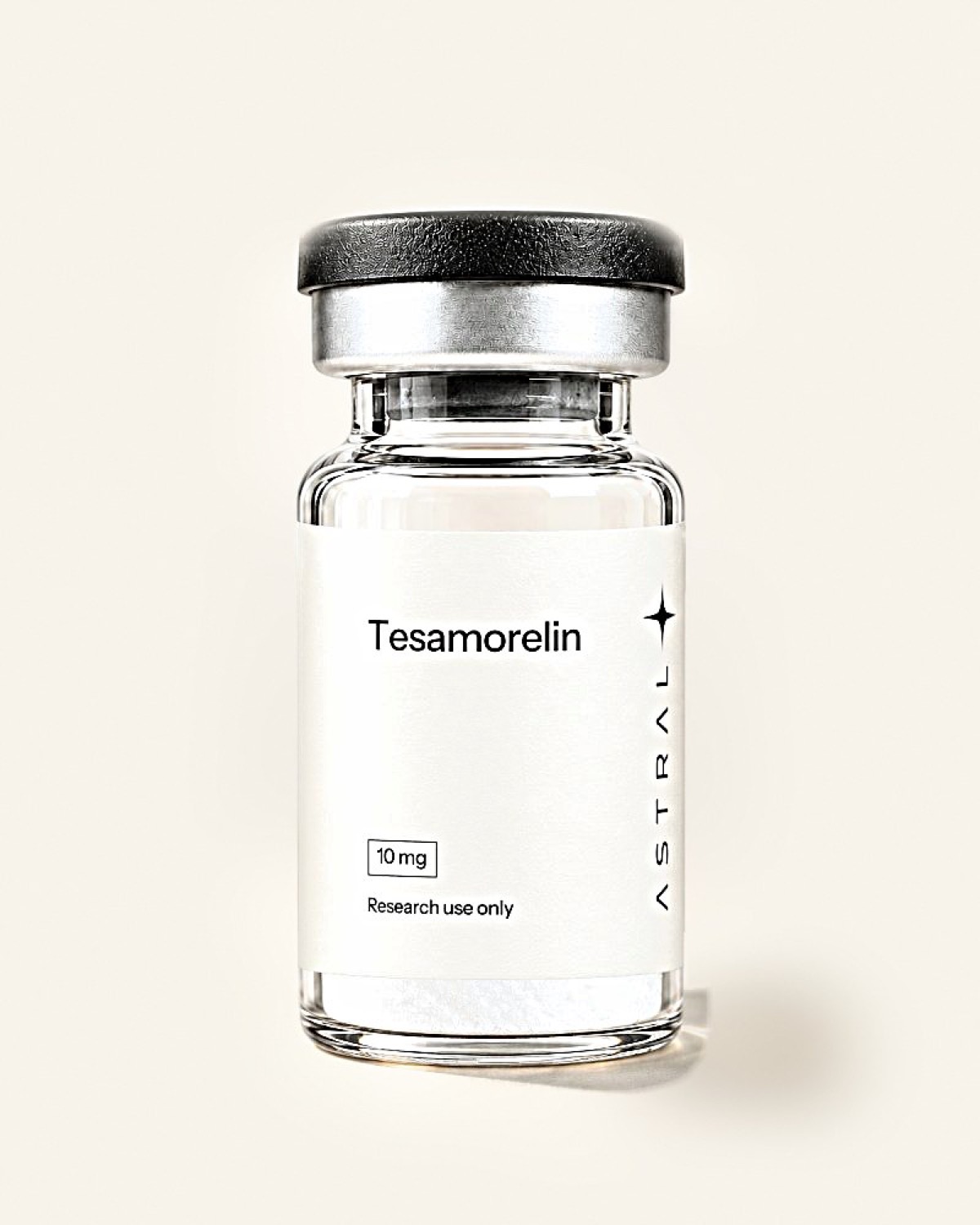
Tesamorelin is a synthetic 44-amino-acid analog of human growth hormone-releasing hormone, or GHRH, that keeps the natural hormone’s full sequence and adds a trans-3-hexenoyl group to its N-terminal tyrosine. Its development code was TH9507, and the FDA approved tesamorelin for injection on November 10, 2010.
The hexenoyl group is the only added piece. The peptide is neither a shortened GHRH fragment nor the same molecule as sermorelin or CJC-1295, and this guide checks the identifiers on Astral’s tesamorelin listing against PubChem and ChEBI before separating the three neighboring analogs by structure.
Table of contents
What is tesamorelin at the molecular level?
Human GHRH begins as part of a 108-amino-acid precursor, and UniProt records the mature hormone as residues 32 through 75 of that precursor, a 44-residue chain ending in leucinamide. In one-letter amino-acid code:
YADAIFTNSYRKVLGQLSARKLLQDIMSRQQGESNQERGARARL-NH₂
Tesamorelin uses that full chain. Its added group is attached to the amino end of the first residue, tyrosine, and the chemical name writes it as (3E)-hex-3-enoyl while the 2007 pharmacology paper used trans-3-hexenoyl. Both names describe a six-carbon chain with a trans double bond between carbons 3 and 4.
| Item | Verified identity |
|---|---|
| Full name | Tesamorelin |
| Other names and codes | TH9507, TH-9507, (3E)-hex-3-enoylsomatoliberin |
| Class | Synthetic analog of human GHRH(1-44)-NH₂ |
| Sequence or structure | trans-3-hexenoyl-YADAIFTNSYRKVLGQLSARKLLQDIMSRQQGESNQERGARARL-NH₂ |
| Length | 44 amino acids |
| Molecular formula | C221H366N72O67S |
| Molar mass | about 5135.9 g/mol |
| CAS number | 218949-48-5 |
| PubChem CID | 16137828 |
| ChEBI ID | CHEBI:63626 |
The small difference between “5136” and “5135.9” is rounding: PubChem uses the whole number, while ChEBI gives a mass of 5135.863. Both databases give the same formula. These values describe the neutral tesamorelin structure. The approved product record names tesamorelin acetate, so a formulated product and the free peptide belong in separate chemical records.
Why does tesamorelin have a trans-3-hexenoyl group?
Frohman’s 1989 enzyme study gave the modification a target. The researchers studied GHRH breakdown in plasma and reported that its main early cleavage occurred between amino acids 2 and 3. Their inhibitor experiments identified dipeptidyl peptidase IV, now shortened to DPP-IV or DPP-4. The resulting fragment was GHRH(3-44)-NH₂.
The paper tested shortened GHRH forms and amino-acid substitutions as well, establishing the N-terminus as a practical place to alter how quickly plasma enzymes cut the molecule.
The TH9507 paper followed in 2007. Researchers described it as human GHRH(1-44)-NH₂ “minimally modified” by a trans-3-hexenoyl group on Tyr1, then reported slower breakdown than natural GHRH and resistance to DPP-IV deactivation in rat, dog and human plasma tested in vitro. The hexenoyl group sat directly at the terminus where the earlier enzyme work had located the first major cut.
How was tesamorelin studied before approval?
The clinical program used both the generic name and TH9507, and a 2007 phase 3 paper described a randomized, placebo-controlled trial with 412 participants and a 26-week primary phase. Its primary endpoint was the percentage change in visceral adipose tissue measured by computed tomography.
A 2010 paper then pooled two multicenter phase 3 studies that had randomized 806 participants, each with a 26-week controlled phase followed by a 26-week extension. It appeared before the FDA decision and recorded the scale and design of the program reviewed that year.
Research continued after approval. A 2014 randomized trial enrolled 50 participants and set changes in visceral adipose tissue and liver fat as its primary endpoints over six months. Its authors called the study preliminary and said that further work was needed to determine the clinical importance and long-term consequences of the findings. That qualification matters. A measured trial endpoint is a historical result, not a general promise about tesamorelin.
Is tesamorelin FDA-approved?
Yes. The FDA approved tesamorelin for injection on November 10, 2010, and the openFDA Drugs@FDA record classifies the original submission as a Type 1 New Molecular Entity with approval-status date 20101110.
Application 22-505 changed categories years after approval. The 2010 approval package called the file application 22-505 and the agency’s summary review identified it as NDA 22505, while openFDA now records BLA022505 and notes that the former NDA was deemed to be a BLA on March 23, 2020. That 2020 action changed the regulatory category of the existing application.
Europe’s file ended at the application stage. A marketing authorization application for tesamorelin was withdrawn on June 21, 2012, after the European Medicines Agency’s committee said the submitted data did not support a positive benefit-risk conclusion. The record is a withdrawn application, not a European approval.
How does tesamorelin compare with sermorelin?
Sermorelin is the first 29 amino acids of human GHRH with an amide at the end, written GHRH(1-29)-NH₂, and PubChem CID 16132413 gives its sequence from Tyr1 through Arg29, formula C149H246N44O42S, and molecular weight 3357.9 g/mol.
Tesamorelin keeps all 44 residues and adds the trans-3-hexenoyl group at Tyr1, while sermorelin stops after residue 29 and has no hexenoyl group in its PubChem structure. Their first 29 residues match, but the remaining chain and terminal chemistry do not.
Tesamorelin vs CJC-1295: what is the difference?
The comparison needs a specific record. PubChem CID 91971820 is CJC-1295 with formula C165H269N47O46 and molecular weight 3647.2 g/mol, and the National Library of Medicine describes that structure as a maleimido derivative of human GHRH(1-29). It uses a shortened and substituted 1-29 core with a maleimide-bearing attachment instead of the intact 44-residue GHRH chain.
In 2024, FDA treated CJC-1295 free base, its acetate salt, CJC-1295 DAC, DAC acetate and DAC TFA as five separate bulk substances. The 29-amino-acid free base had formula C152H252N44O42 and molecular weight 3367.95 g/mol, while the DAC free-base structure carried C165H269N47O46, the formula in PubChem CID 91971820. FDA also found a public identifier that paired the free-base name with the DAC structure. This comparison therefore uses CID 91971820 rather than the name alone.
Tesamorelin is larger because it retains residues 30 through 44, and its modification is a trans-3-hexenoyl group on Tyr1 rather than the maleimido attachment represented by CID 91971820. “Tesamorelin vs CJC-1295” therefore comes down to two structural differences: chain length and terminal chemistry.
The name CJC-1295 is also used loosely online. The PubChem record above is the maleimido form. Pages that say “CJC-1295 without DAC” point to a different chemical structure, often called modified GHRH(1-29), and our CJC-1295 and ipamorelin guide handles that naming split. The CJC-1295 and ipamorelin blend is labeled without DAC.
| Feature | Tesamorelin | Sermorelin | CJC-1295, CID 91971820 |
|---|---|---|---|
| GHRH-derived chain | Full 1-44 sequence | First 29 residues | Modified 1-29 core |
| Distinguishing chemistry | trans-3-hexenoyl group on Tyr1 | C-terminal amide at Arg29 | Maleimide-bearing attachment |
| PubChem CID | 16137828 | 16132413 | 91971820 |
| Molecular weight | about 5135.9 g/mol | 3357.9 g/mol | 3647.2 g/mol |
Where should a tesamorelin record start?
The identifiers come first. A record that says tesamorelin should agree on the 44-residue sequence, the N-terminal trans-3-hexenoyl group, CAS 218949-48-5 and PubChem CID 16137828. The formula and molar mass then serve as cross-checks. Astral’s tesamorelin product record lists the same CAS number, formula and rounded mass.
Bench handling belongs in a separate record. The peptide storage guide covers dry and reconstituted material, and How to reconstitute peptides covers the bench sequence without mixing it into the compound’s history.
Common questions
What is tesamorelin?
Tesamorelin is a synthetic 44-amino-acid analog of human GHRH with the natural GHRH(1-44)-NH₂ sequence plus a trans-3-hexenoyl group attached to its first amino acid, tyrosine.
Is tesamorelin a peptide?
Yes. Tesamorelin is a 44-amino-acid peptide with one non-peptide acyl group at its N-terminus. PubChem identifies it as CID 16137828.
What is the tesamorelin structure?
Its peptide sequence is YADAIFTNSYRKVLGQLSARKLLQDIMSRQQGESNQERGARARL-NH₂. A trans-3-hexenoyl group is attached to the N-terminal tyrosine, giving the formula C221H366N72O67S.
Is tesamorelin FDA-approved?
Yes. The FDA approved tesamorelin for injection on November 10, 2010, as a Type 1 New Molecular Entity under application 22-505, now recorded as BLA022505 after the former NDA was deemed a BLA in 2020.
What is the difference between tesamorelin and CJC-1295?
Tesamorelin uses the full 44-residue human GHRH sequence with a trans-3-hexenoyl group at Tyr1, while CJC-1295 in PubChem CID 91971820 uses a modified GHRH(1-29) core with a maleimide-bearing attachment.
Is tesamorelin the same as sermorelin?
No. Sermorelin is GHRH(1-29)-NH₂, while tesamorelin contains all 44 GHRH residues and an N-terminal trans-3-hexenoyl group.
Sources
- Tesamorelin, compound summary (CID 16137828) PubChem, National Library of Medicine
- Tesamorelin (CHEBI:63626) ChEBI, European Bioinformatics Institute
- Human somatoliberin precursor (P01286) UniProt
- Frohman LA, Downs TR, Heimer EP, Felix AM Dipeptidylpeptidase IV and trypsin-like enzymatic degradation of human growth hormone-releasing hormone in plasma. Journal of Clinical Investigation (1989)
- Ferdinandi ES, Brazeau P, High K, et al Non-clinical pharmacology and safety evaluation of TH9507, a human growth hormone-releasing factor analogue. Basic & Clinical Pharmacology & Toxicology (2007)
- Falutz J, Allas S, Blot K, et al Metabolic effects of a growth hormone-releasing factor in patients with HIV. New England Journal of Medicine (2007)
- Falutz J, Mamputu JC, Potvin D, et al Effects of tesamorelin (TH9507), a growth hormone-releasing factor analog, in HIV-infected patients with excess abdominal fat: a pooled analysis of two phase 3 trials. Journal of Clinical Endocrinology & Metabolism (2010)
- Stanley TL, Feldpausch MN, Oh J, et al Effect of tesamorelin on visceral fat and liver fat in HIV-infected patients with abdominal fat accumulation: a randomized clinical trial. JAMA (2014)
- Tesamorelin for injection approval package, application 22-505 U.S. Food and Drug Administration (2010)
- Tesamorelin application record, BLA022505 openFDA Drugs@FDA
- European marketing authorization record for tesamorelin European Medicines Agency
- Sermorelin, compound summary (CID 16132413) PubChem, National Library of Medicine
- CJC-1295, compound summary (CID 91971820) PubChem, National Library of Medicine
- CJC-1295 briefing document U.S. Food and Drug Administration (2024)