MT1 Peptide: What Is MT-1 (Melanotan 1)?
MT-1, Melanotan 1, afamelanotide and NDP-MSH are four names for one 13-amino-acid molecule. Here is what it is, where it came from and how it differs from Melanotan 2.
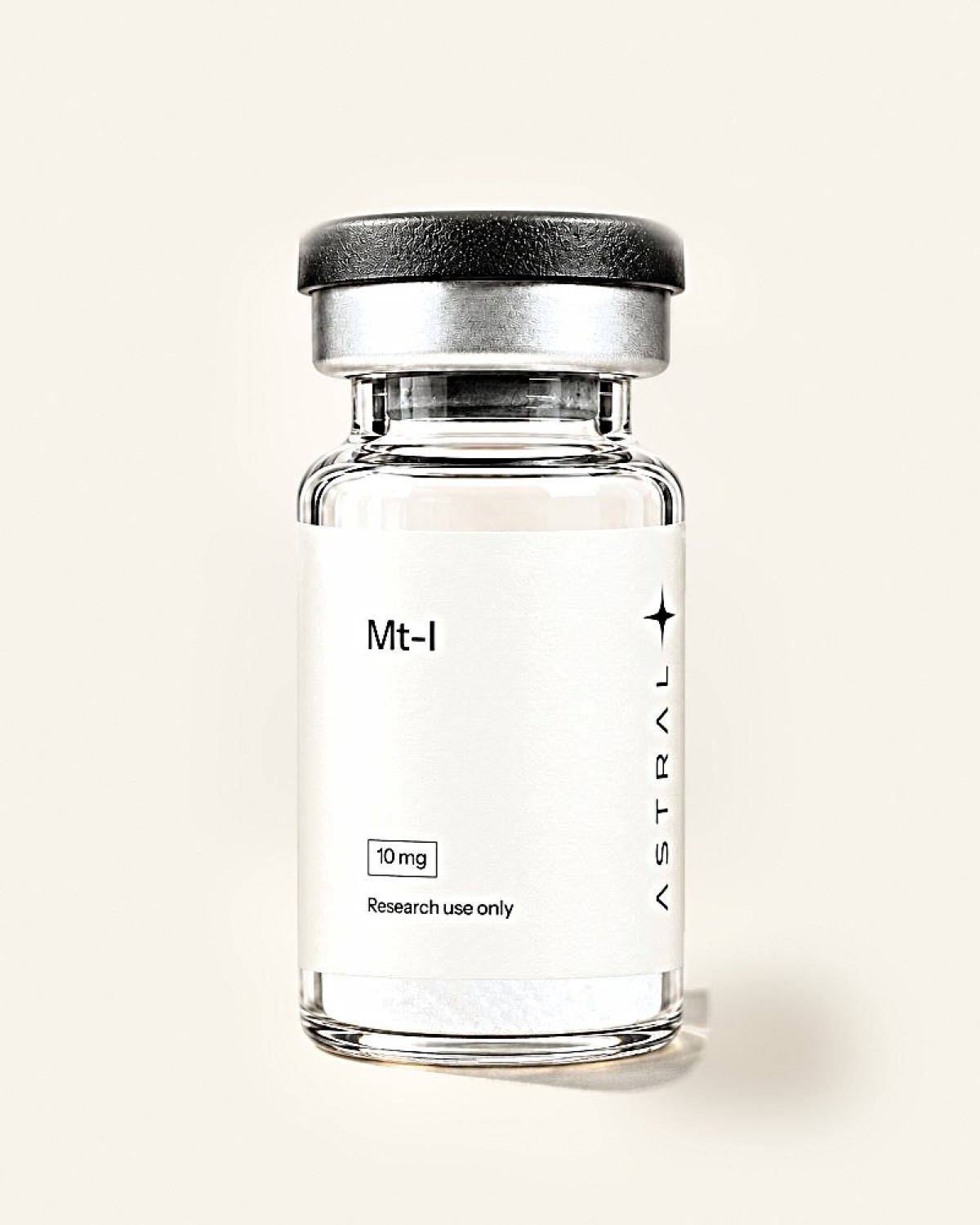
The MT1 peptide, also written MT-1, Mt-I or Melanotan 1, is afamelanotide, a lab-made copy of the 13-amino-acid hormone alpha-MSH with two of its amino acids swapped. Chemists write it [Nle4, D-Phe7]-α-MSH, which names the two swaps and where they sit. It was first made in 1980, and under its generic name it is an approved medicine in the European Union and the United States.
Astral lists MT-1 as a freeze-dried powder in a 10 mg vial, CAS 75921-69-6. The compound collects more names than most, and one of them, MT1, also belongs to an unrelated receptor. This page sorts the names, sets the structure beside the natural hormone, walks through the history, and puts MT-1 next to Melanotan 2.
Table of contents
What is the MT1 peptide?
It is a linear chain of 13 amino acids with an acetyl cap on the front end and an amide cap on the tail. The sequence is the same as human alpha-MSH (alpha-melanocyte-stimulating hormone) at 11 of 13 positions. Position 4 holds norleucine where the hormone has methionine, and position 7 holds D-phenylalanine, the mirror-image form of the phenylalanine found there in nature.
| Item | Value |
|---|---|
| Generic name | Afamelanotide |
| Other names and codes | Melanotan 1, Melanotan I, MT-1, MT-I, NDP-MSH, NDP-α-MSH, CUV1647 |
| Class | Synthetic linear peptide, analog of alpha-MSH |
| Sequence | Ac-Ser-Tyr-Ser-Nle-Glu-His-D-Phe-Arg-Trp-Gly-Lys-Pro-Val-NH₂ |
| Length | 13 amino acids |
| Molecular formula | C78H111N21O19 |
| Molar mass | 1646.8 g/mol (PubChem). The FDA label gives 1646.85 |
| CAS number | 75921-69-6 |
| PubChem CID | 16197727 |
| Form in the Astral catalog | Lyophilized powder, 10 mg vial |
The molar mass shows up as 1646.8, 1646.85 or 1646.9 depending on the source. Those are one number rounded three ways, and they describe the peptide alone. The approved drug substance is the acetate salt, which carries three to four acetic acid molecules per peptide and so weighs more per mole.
Is Melanotan 1 the same as afamelanotide?
Yes. PubChem files Melanotan I, Melanotan-1, MT-1, NDP-MSH, CUV1647 and afamelanotide as synonyms under one record with one CAS number. Afamelanotide is the international nonproprietary name, the generic name a drug is given so that it can be written about without a brand. Melanotan I is the older research name. NDP-MSH is shorthand for the two swaps: N for norleucine, DP for D-phenylalanine.
Searches for the MT-1 peptide run into one real source of confusion. In pharmacology, MT1 without a hyphen is also the official name of a melatonin receptor, one of the two receptors that read the hormone melatonin. That MT1 is a protein in cell membranes and has nothing to do with this peptide. A search for “mt1 peptide” can land on either, so check for the CAS number, 75921-69-6, or the sequence. Both are unambiguous in a way the abbreviation never will be.
How does MT-1 differ from natural alpha-MSH?
By two residues out of 13. Alpha-MSH is cut from a larger precursor protein called POMC, and its sequence was published in Nature in 1957. Set the two chains side by side:
| Position | 1 | 2 | 3 | 4 | 5 | 6 | 7 | 8 | 9 | 10 | 11 | 12 | 13 |
|---|---|---|---|---|---|---|---|---|---|---|---|---|---|
| Alpha-MSH | Ser | Tyr | Ser | Met | Glu | His | Phe | Arg | Trp | Gly | Lys | Pro | Val |
| MT-1 | Ser | Tyr | Ser | Nle | Glu | His | D-Phe | Arg | Trp | Gly | Lys | Pro | Val |
Methionine contains a sulfur atom, and methionine is one of the residues oxygen attacks in a stored peptide. Norleucine is close to the same shape with a plain carbon chain where the sulfur was. You can see the swap in the formulas. Alpha-MSH is C77H109N21O19S and MT-1 is C78H111N21O19, with no sulfur left in it. The second swap changes nothing in the formula, because D-phenylalanine has the same atoms as the natural form arranged as its mirror image.
The 1980 paper that introduced the molecule reported what those two changes did in the lab. The analog resisted breakdown by serum enzymes, its activity in a frog-skin assay lasted far longer than the hormone’s, and it was 26 times as potent as alpha-MSH in a mouse melanoma enzyme assay.
One detail connects it to another catalog compound. The last three residues, Lys-Pro-Val, are untouched, and that tail on its own is the tripeptide KPV. Our guide to what KPV is covers that fragment.
Where did Melanotan 1 come from?
From the University of Arizona in Tucson. The synthesis was published in the Proceedings of the National Academy of Sciences in October 1980 by Sawyer, Hruby, Hadley and colleagues. They had noticed that heating alpha-MSH in alkali made its activity last longer, traced that to residues 4 and 7 partly flipping into their mirror-image forms, and then built the stable version on purpose. The authors proposed it as a molecular probe for studying the receptors that melanotropins act on.
It became a clinical candidate at the same university. A randomized, placebo-controlled trial run at the University of Arizona Health Sciences Center and published in JAMA in 1991 gave the peptide or saline to 28 volunteers and measured skin color with an instrument for seven weeks afterward. The group that received the peptide darkened and the placebo group did not. A 2006 review by Hadley and Dorr, both at Arizona, records that the linear peptide and a later cyclic one were patented under the names melanotan I and melanotan II.
A 2017 pharmacokinetics review calls afamelanotide the first alpha-MSH analog to be synthesized and the first to be given to human volunteers.
Is afamelanotide FDA-approved?
Yes, for one rare disease and in one dosage form. On October 8, 2019, the FDA approved an afamelanotide implant to increase pain-free light exposure in adults with a history of phototoxic reactions from erythropoietic protoporphyria, a rare disorder in which light on the skin causes severe pain. The European Commission had authorized it for the same disease on December 22, 2014, under the “exceptional circumstances” route used when a condition is too rare for complete data.
The trials behind those decisions were published in the New England Journal of Medicine in 2015: two multicenter, placebo-controlled studies, one in the European Union and one in the United States.
The approval covers a specific product, a small controlled-release implant made with the acetate salt. It does not extend to afamelanotide in other forms, and it is not approved for any other use.
Melanotan 1 vs Melanotan 2: what is the difference?
They are different molecules from the same Arizona laboratory. Melanotan 2, or MT-II, came out of work the group published in 1989, when it shortened the chain to seven residues and tied it into a ring with a lactam bridge between two side chains. It keeps the norleucine and the D-phenylalanine. Everything else about its shape changed.
| MT-1 (Melanotan 1) | MT-2 (Melanotan 2) | |
|---|---|---|
| Shape | Linear | Cyclic, closed by a lactam bridge |
| Length | 13 amino acids | 7 amino acids |
| Sequence | Ac-Ser-Tyr-Ser-Nle-Glu-His-D-Phe-Arg-Trp-Gly-Lys-Pro-Val-NH₂ | Ac-Nle-cyclo[Asp-His-D-Phe-Arg-Trp-Lys]-NH₂ |
| Molecular formula | C78H111N21O19 | C50H69N15O9 |
| Molar mass | 1646.8 g/mol | 1024.2 g/mol |
| CAS number | 75921-69-6 | 121062-08-6 |
| PubChem CID | 16197727 | 92432 |
| FDA status | Approved in 2019 as an implant, one indication | Not approved |
| Astral catalog | 10 mg vial | Not stocked |
The names differ by one digit and the compounds are entirely separate. The fastest check on any listing is the CAS number or the molar mass, since 1646.8 and 1024.2 cannot be mistaken for each other. A certificate of analysis that reports a mass near 1647 is describing MT-1.
MT-2 itself has no FDA approval. A close relative has. Bremelanotide is the same seven-residue ring with a free acid at the tail where MT-2 has an amide, and the FDA approved it on June 21, 2019.
How is MT-1 handled at the bench?
The FDA label describes afamelanotide as a white to off-white powder that is freely soluble in water, and it directs that the approved implant be kept refrigerated at 2 to 8 °C and protected from light. A research vial is a different format, a lyophilized cake, so the general rules for freeze-dried peptides apply: sealed, cold, dry and dark until use. Dark matters here, because the chain still carries tryptophan and tyrosine, two of the residues UV light can oxidize. Our peptide storage guide has the windows for freezer and refrigerator.
The arithmetic is simple. At 1646.8 g/mol, a 10 mg vial holds about 6.07 micromoles. Add 2 mL of Reconstitution Solution and the result is 5 mg/mL, which is about 3.04 millimolar. The peptide calculator does the division for any volume, and How to reconstitute peptides has the steps.
MT-1 is a natural hormone with a few deliberate edits, and it has company in the catalog. Tesamorelin is an edited form of a different hormone, built on the same idea of changing a few residues so the chain survives longer. The vial itself is on the MT-1 product page.
Common questions
Is the MT1 peptide the same as Melanotan 1?
Yes. MT1, MT-1 and Mt-I are abbreviations of Melanotan 1, whose generic name is afamelanotide, CAS 75921-69-6. The unhyphenated MT1 is also the name of a melatonin receptor, which is an unrelated protein.
Is Melanotan 1 the same as afamelanotide?
Yes. Afamelanotide is the international generic name for the molecule first published as [Nle4, D-Phe7]-α-MSH and later called Melanotan I. NDP-MSH and CUV1647 are further names for the same 13-amino-acid peptide.
What is the difference between Melanotan 1 and Melanotan 2?
Melanotan 1 is a linear peptide of 13 amino acids with a molar mass of 1646.8 g/mol. Melanotan 2 is a cyclic peptide of 7 amino acids at 1024.2 g/mol. They have different sequences and different CAS numbers.
Is afamelanotide approved by the FDA?
Yes. The FDA approved an afamelanotide implant on October 8, 2019, for adults with erythropoietic protoporphyria. It is not approved for any other use.
What is the sequence of MT-1?
Ac-Ser-Tyr-Ser-Nle-Glu-His-D-Phe-Arg-Trp-Gly-Lys-Pro-Val-NH₂. It matches alpha-MSH except at position 4, where norleucine replaces methionine, and position 7, where D-phenylalanine replaces L-phenylalanine.
How many micromoles are in a 10 mg vial of MT-1?
About 6.07. That is 0.010 grams divided by the molar mass of 1646.8 g/mol.
Sources
- Afamelanotide, compound summary CID 16197727. PubChem, National Library of Medicine (2026)
- Melanotan II, compound summary CID 92432. PubChem, National Library of Medicine (2026)
- Alpha-MSH, compound summary CID 16133793. PubChem, National Library of Medicine (2026)
- Sawyer TK, Sanfilippo PJ, Hruby VJ, et al 4-Norleucine, 7-D-phenylalanine-alpha-melanocyte-stimulating hormone: a highly potent alpha-melanotropin with ultralong biological activity. Proceedings of the National Academy of Sciences (1980)
- Harris JI, Lerner AB Amino-acid sequence of the alpha-melanocyte-stimulating hormone. Nature (1957)
- Pro-opiomelanocortin, human P01189. UniProt (2026)
- Levine N, Sheftel SN, Eytan T, et al Induction of skin tanning by subcutaneous administration of a potent synthetic melanotropin. JAMA (1991)
- Al-Obeidi F, Castrucci AM, Hadley ME, Hruby VJ Potent and prolonged acting cyclic lactam analogues of alpha-melanotropin: design based on molecular dynamics. Journal of Medicinal Chemistry (1989)
- Hadley ME, Dorr RT Melanocortin peptide therapeutics: historical milestones, clinical studies and commercialization. Peptides (2006)
- Minder EI, Barman-Aksoezen J, Schneider-Yin X Pharmacokinetics and pharmacodynamics of afamelanotide and its clinical use in treating dermatologic disorders. Clinical Pharmacokinetics (2017)
- Langendonk JG, Balwani M, Anderson KE, et al Afamelanotide for erythropoietic protoporphyria. New England Journal of Medicine (2015)
- Afamelanotide implant, prescribing information DailyMed
- FDA, Drugs@FDA data NDA 210797, afamelanotide, original approval October 8 (2019)
- Dubocovich ML, Delagrange P, Krause DN, et al International Union of Basic and Clinical Pharmacology. LXXV. Nomenclature, classification, and pharmacology of G protein-coupled melatonin receptors. Pharmacological Reviews (2010)