Why is my peptide cloudy after reconstitution?
A freshly mixed vial should be clear. Here is what each departure from clear means, the chemistry behind it, and what a lab does about each one.
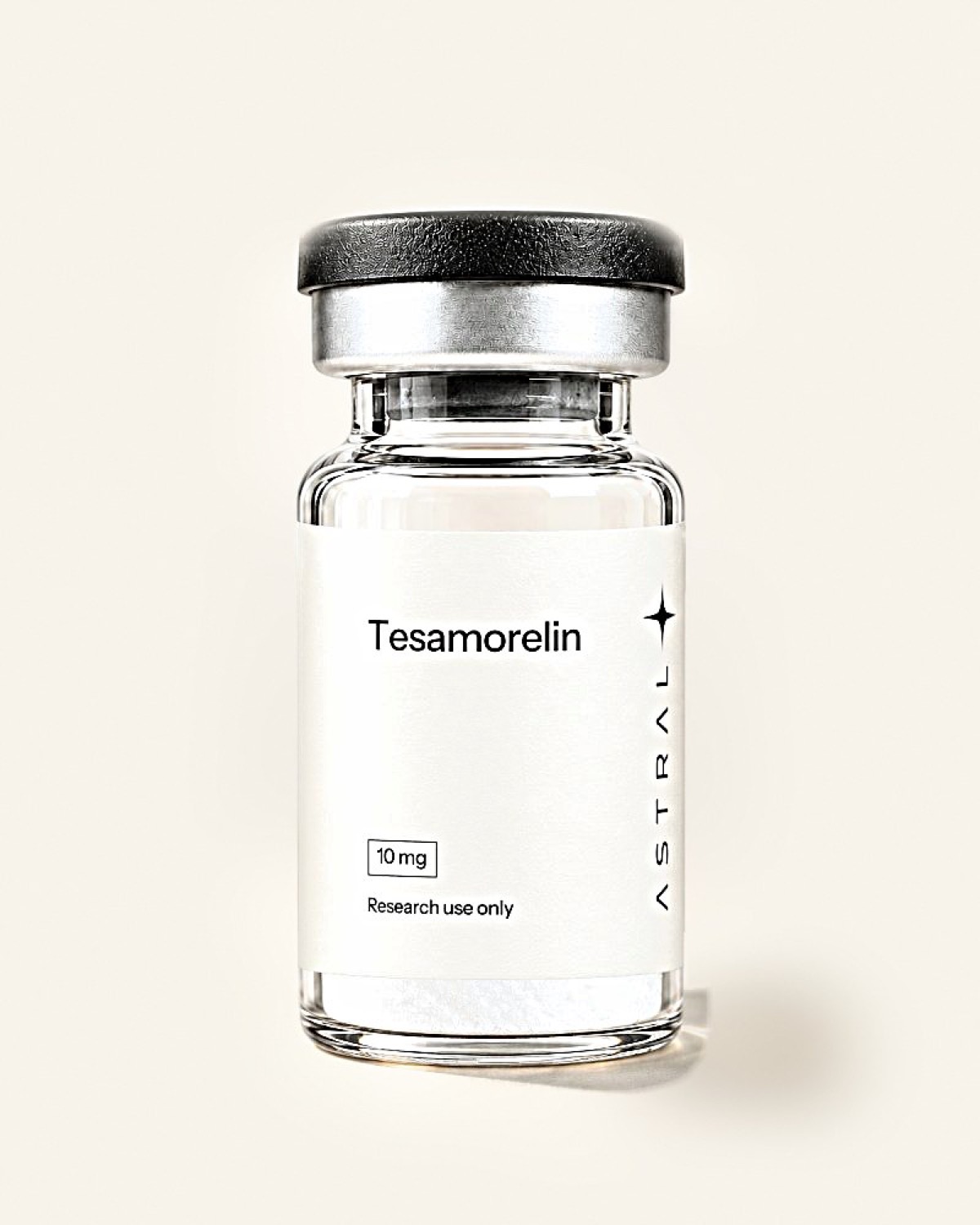
A freshly reconstituted peptide should be a clear, colorless, water-like solution with nothing floating in it, the blue of GHK-Cu being the one expected exception. Cloudiness that fades within a few minutes of gentle swirling, or as a cold vial reaches room temperature, is usually powder still dissolving or a reversible cold haze. Cloudiness that stays once the vial is at room temperature, or any specks, strands or gel, means peptide has come out of solution or something has gotten in, and a lab discards that vial.
The pages that rank for this question disagree, some calling every cloudy vial harmless and some calling every one ruined. The evidence supports neither. The mixing steps are in How to reconstitute peptides. This page starts at the moment the powder meets the liquid.
Table of contents
What should a freshly mixed peptide vial look like?
Clear. Prescribing information for freeze-dried peptide products says so in the same words. The tesamorelin label reads, “Use only if the solution is clear, colorless and without particulate matter,” and the glucagon label asks for a solution that is “clear and of water-like consistency.”
Cloudiness is light scattered by particles too small to see singly. A study of an opalescent antibody solution found the haze was ordinary Rayleigh scatter from the molecules themselves and not a sign of instability. Color is the other check. GHK-Cu, and blends that carry it such as GLOW, dissolve blue because of the copper in the complex. Any other color change is a reason to stop.
Why does a peptide go cloudy after mixing?
Peptide molecules stick to each other, which the literature calls aggregation. A 2017 review of peptide stability by Zapadka and colleagues lists the drivers: concentration, pH and net charge, surfaces and interfaces, temperature, agitation, and freeze-drying itself.
Concentration comes first. The review calls it “one of the most important factors influencing the physical stability of peptides.” A vial that will not clear at a high concentration will often clear with more solvent. Add it, recalculate with the peptide calculator, and relabel.
Charge is second. Each peptide carries acidic and basic groups whose charge depends on the pH around them. At the pH where those charges cancel, the isoelectric point, the molecules stop repelling one another, and the review’s rule is plain: “the lower the net charge the higher the propensity to aggregate.” Bacteriostatic water has a pH of 5.7 within a permitted range of 4.5 to 7.0, which suits most peptides. Bachem’s handling notes put overall acidic peptides in basic solvents and overall basic peptides in acidic ones for the same reason.
Benzyl alcohol is third. The 0.9% preservative in Reconstitution Solution is what lets a vial be drawn from for weeks, and a 2023 review in Pharmaceutics notes that the presence of certain preservatives “has been reported to increase protein and peptide particle formation.” In one well-studied case, a protein aggregated faster in 0.9% benzyl alcohol at neutral pH, with the effect “much greater at 37 degrees C than at 25 degrees C.” The preservative is a mild stress that warmth amplifies, so a mixed vial goes into the refrigerator rather than sitting on a warm bench, and a compound whose sheet calls for unpreserved water gets it. The choice is laid out in bacteriostatic water vs sterile water.
Why is my peptide cloudy when cold, and will it clear at room temperature?
Often, yes. In the antibody study above, the opalescence “was greater at refrigerated temperature but was readily reversible upon warming to room temperature.” Condensation fogs the outside of cold glass, so wipe the vial before judging it. And a cold vial opened at once pulls moisture inside, as the storage guide explains, so let it warm sealed.
Let the vial reach room temperature on the bench, out of direct light, and look again. Do not hurry it in warm water or in your hands, since Bachem warns that “excessive warming of the sample should be avoided.” If the haze is still there at room temperature, it is no longer a cold haze. A reconstituted vial that was frozen and thawed is different. Ice crystals push peptides together, and that cloudiness does not reverse.
Why is my peptide foamy, or full of bubbles, after reconstitution?
Foam is air forced into the liquid and then held there. A stream fired at the powder or a shaken vial entrains air. The Zapadka review explains that the boundary between air and water behaves as a hydrophobic surface, that peptides stick to it through their hydrophobic side chains, and that molecules sitting at a surface “are no longer in solution.” A foam is a very large air-water surface, which is why the reconstitution guide says to run solvent down the glass and swirl rather than shake.
Bubbles alone are less serious. Many vials are sealed under a slight vacuum and pull solvent in quickly, leaving small bubbles that climb the glass and vanish within minutes. The FDA’s guidance on visible particulates defines a particulate as an undissolved particle “other than gas bubbles,” so a bubble that rises and pops was never the problem. A vial that did not draw the solvent in at all is covered in peptide vial has no vacuum.
Why won’t my peptide powder dissolve, or why is it clumped together?
Freeze-dried peptide arrives as a cake, and cakes vary. A 2017 commentary by Patel and colleagues notes that in some cases “a non-ideal cake appearance has no impact on product quality” and is simply a property of the product. A cake that broke into loose powder in transit is not by itself a bad vial. What matters is whether it dissolves.
Give it time. Bachem’s notes say “the reconstitution of a peptide may take time, occasionally up to several hours,” and that a few minutes in a water-bath sonicator can speed the dissolution of larger particles. Otherwise, slow swirling and more solvent do the work. Three things make a cake slow. Concentration, as above. Moisture, because a cake that took on water in storage dissolves unevenly, which is why the storage guide lists powder that will not dissolve among the signs of a damp vial. And sequence, because strongly hydrophobic peptides are poor fits for plain water and need the solvent their technical sheet names. If the vial has warmed, had gentle swirling and fifteen minutes, had a top-up of solvent, and still holds a lump or a drift of grains, the reconstitution guide’s rule applies: do not use it.
What are the white particles or floating specks in my peptide vial?
The FDA guidance sorts particulates into three families. Inherent particulates are “an innate product characteristic,” which for a peptide means the peptide itself, aggregated into wisps, strands or snow that drift when the vial is tilted. Intrinsic particulates come from “components, containers and closures (e.g., glass vials, rubber stoppers).” Extrinsic particulates are fibers, hair and dust from outside.
The rubber kind has a specific cause. Pushing a needle through a stopper can shave out a plug of rubber, called coring, which lands in the vial as a dark fleck that never dissolves. In one study, blunt needles cored 40.8% of vials against 4.2% for sharp ones, and another found large-bore needles the main culprit. A fine, sharp needle pushed straight through once is the prevention. Whatever the family, note what you saw and the lot number, and discard the vial.
Why has my peptide turned into a gel?
Some peptides assemble into long fibrils, and the Zapadka review notes that “a number of peptides that self-assemble into fibrillar structures have also been shown to form hydrogels.” Glucagon, which forms fibrils within a day at 2.5 mg/mL or more in acidic solution, carries a label instruction to discard the solution “if there are signs of gel formation or particles.” A gel does not swirl back into solution.
What you see, what it usually means, what to do
| What you see | What it usually means | What a lab does |
|---|---|---|
| Faint, even haze that clears within 20 minutes at room temperature | Reversible cold haze, or powder still dissolving | Wait, swirl gently, note it |
| Fog on the outside of the glass | Condensation on a cold vial | Wipe it and look again |
| Foam or bubbles | Air forced in by a fast stream, shaking or a quick vacuum draw | Let it settle, do not shake, then inspect |
| Lump or grains that shrink with swirling | Slow dissolution, often a high concentration | Add solvent, recalculate |
| Lump or grains unchanged after 15 minutes at room temperature | Insoluble material, a damp cake, or the wrong solvent | Discard |
| Haze that stays at room temperature | Aggregated peptide | Discard |
| White wisps, strands or snow that drift | Peptide aggregate | Discard |
| Dark fleck that sinks | Rubber from the stopper, or glass | Discard, finer sharp needle next time |
| Thickened liquid or gel | Fibril formation | Discard |
| Color change other than GHK-Cu blue | Oxidation or contamination | Discard |
When should I discard a cloudy peptide?
When it is still cloudy at room temperature. The reversible haze is real and documented, and it goes away. Everything that does not go away is peptide that has left solution or material that was never peptide. Write down what the solution looked like on the day you mixed it, so a later worry has something to be compared against.
Common questions
Can I still use a peptide that is cloudy after reconstitution?
Not while it is cloudy at room temperature. Let it warm, swirl gently and give it fifteen minutes. If it clears, the haze was cold or slow dissolution. If not, the vial is discarded.
Why is my peptide cloudy when cold?
Some solutions scatter more light when chilled, an effect that is “readily reversible upon warming to room temperature” in the published case. Wipe the condensation off the outside first. If the haze remains at room temperature, the cold was not the cause.
Are bubbles in a peptide vial after reconstitution a problem?
Bubbles that rise and vanish within minutes are air that came in with the solvent, not particulates. A standing foam should settle fully before the solution is judged.
What are the white particles in my peptide vial?
Drifting white wisps or strands are usually the peptide itself, aggregated out of solution. Dark specks that sink are more often rubber cored from the stopper, or glass. Either way the vial is not used.
Why is my peptide powder clumped together and not dissolving?
A clumped cake can be normal. Give it time, gentle swirling and, if needed, more solvent with the concentration recalculated. A clump unchanged after fifteen minutes at room temperature is not dissolving, and the vial is discarded.
Sources
- Tesamorelin for injection, prescribing information and instructions for use DailyMed, National Library of Medicine
- Glucagon for Injection, lyophilized powder, prescribing information Fresenius Kabi, via DailyMed, National Library of Medicine
- Bacteriostatic Water for Injection, USP, prescribing information Hospira, via DailyMed, National Library of Medicine
- Inspection of Injectable Products for Visible Particulates, draft guidance for industry U.S. Food and Drug Administration (2021)
- Factors affecting the physical stability (aggregation) of peptide therapeutics Zapadka KL, Becher FJ, Gomes dos Santos AL, Jackson SE. Interface Focus (2017)
- Opalescent appearance of an IgG1 antibody at high concentrations and its relationship to noncovalent association Sukumar M, Doyle BL, Combs JL, Pekar AH. Pharmaceutical Research (2004)
- Effects of pH, temperature, and sucrose on benzyl alcohol-induced aggregation of recombinant human granulocyte colony stimulating factor Thirumangalathu R, Krishnan S, Brems DN, Randolph TW, Carpenter JF. Journal of Pharmaceutical Sciences (2006)
- Antimicrobial Preservatives for Protein and Peptide Formulations: An Overview Stroppel L, Schultz-Fademrecht T, Cebulla M, et al. Pharmaceutics (2023)
- Lyophilized Drug Product Cake Appearance: What Is Acceptable? Patel SM, Nail SL, Pikal MJ, et al. Journal of Pharmaceutical Sciences (2017)
- Mishandling of the therapeutic peptide glucagon generates cytotoxic amyloidogenic fibrils Onoue S, Ohshima K, Debari K, et al. Pharmaceutical Research (2004)
- The impact of needle size and angle on rubber coring after multiple puncturing of multi-dose propofol vial rubber stoppers Chotikawanich T, Kammee T, Khantee S. Heliyon (2022)
- The incidence of coring with blunt versus sharp needles Wani T, Wadhwa A, Tobias JD. Journal of Clinical Anesthesia (2014)
- Peptide solubility Bachem knowledge hub (2021)