TB-500: What It Is, and Is It Thymosin Beta-4?
TB-500 is one name used for two different molecules. Here is what each one is, where the name came from, and how to tell which is in a vial.
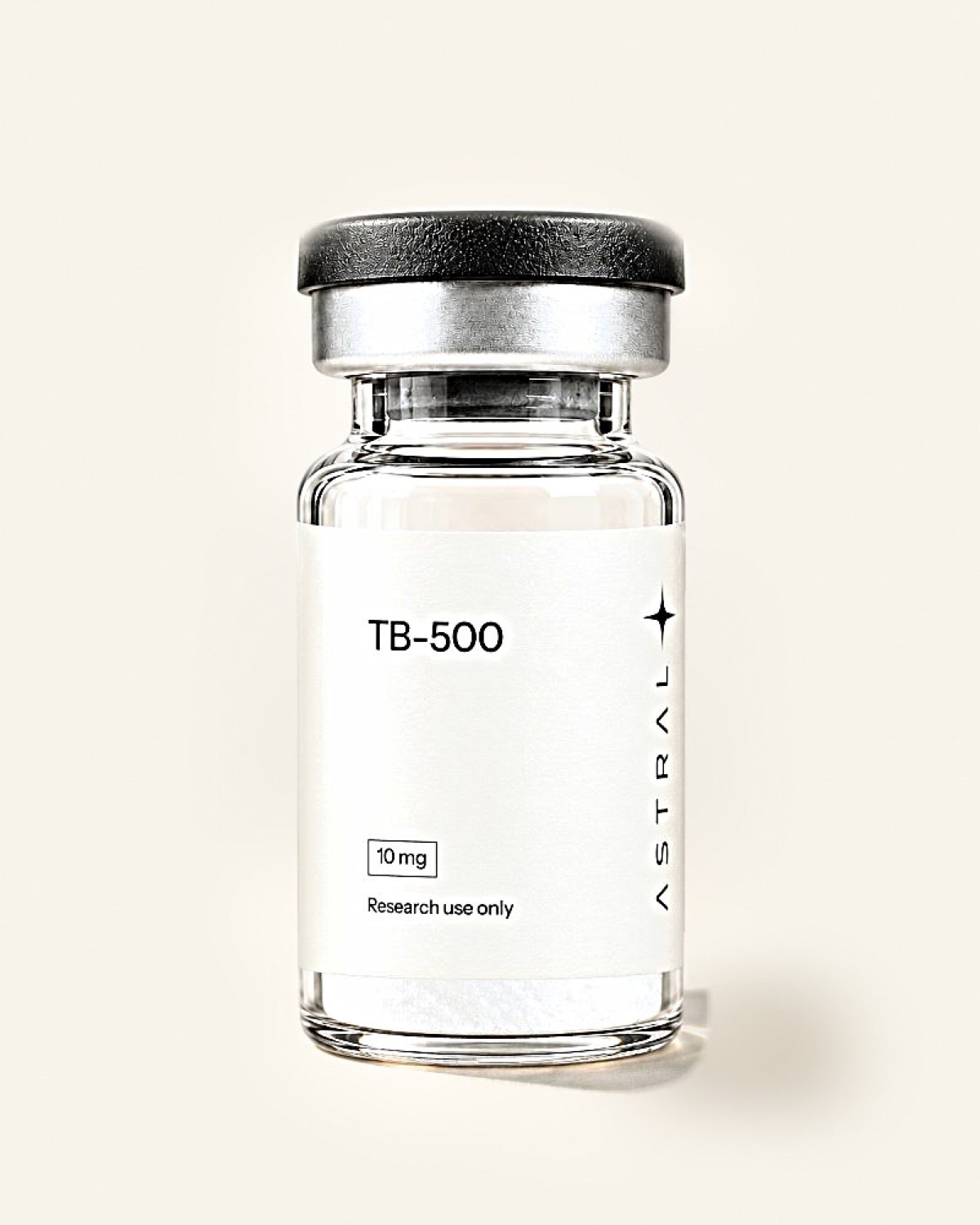
TB-500, also typed TB 500 or TB500, is a lab-made peptide tied to thymosin beta-4, a 43-amino-acid chain found in nearly every cell. The name is used for two different molecules. In the analytical literature TB-500 is a seven-amino-acid piece of thymosin beta-4 with an acetyl cap, Ac-LKKTETQ, while much of the research-peptide market uses the same name for the full 43-amino-acid chain.
The two differ more than fivefold in size, so the label alone does not settle which is in a vial. The numbers do. Astral lists TB-500 in a 10 mg vial with CAS 77591-33-4 and a molar mass of 4963.44 g/mol, which are the identifiers of full-length thymosin beta-4. This page lays out both molecules, the papers that defined the name, and the three numbers that tell them apart.
Table of contents
What are the identifiers for TB-500 and thymosin beta-4?
Each molecule has its own CAS number, formula, molar mass and PubChem record. Side by side:
| Item | Thymosin beta-4 (full length) | TB-500 fragment |
|---|---|---|
| Full name | Thymosin beta-4 | N-acetyl thymosin beta-4 (17-23) |
| Other names and codes | Tβ4, Fx peptide, timbetasin | TB-500, TB500, Ac-LKKTETQ |
| Class | Synthetic copy of a natural 43-amino-acid peptide | Synthetic 7-amino-acid peptide |
| Sequence | Ac-SDKPDMAEIEKFDKSKLKKTETQEKNPLPSKETIEQEKQAGES | Ac-LKKTETQ |
| Molecular formula | C212H350N56O78S | C38H68N10O14 |
| Molar mass | 4963 g/mol | 889.0 g/mol |
| CAS number | 77591-33-4 | 885340-08-9 |
| PubChem CID | 16132341 | 62707662 |
Every value is from PubChem, and the long sequence matches the human entry in UniProt. One detail is worth a second look. PubChem files the names “TB-500” and “TB500” under the short fragment and files “timbetasin”, the generic name assigned to thymosin beta-4, under the 43-amino-acid chain.
What is thymosin beta-4?
Thymosin beta-4 is a small peptide that cells make to manage actin, the protein they use to hold a shape and to move. It was first purified from calf thymus. In 1981 Low, Hu and Goldstein published its full sequence in PNAS and reported 43 amino acids with an acetyl group blocking the front end of the chain.
For a decade it was treated as a thymus hormone. Then, in 1991, a group at the University of Pennsylvania sequenced an actin-binding peptide they had found in human platelets, which they had been calling Fx, and reported that it was identical to thymosin beta-4. Their paper described it binding single actin units one-to-one and keeping them from assembling into filaments. A 2010 review in the FASEB Journal went on to call it the major actin-sequestering molecule in cells and noted that it turns up in essentially all cells and body fluids.
The human gene is TMSB4X. It codes for 44 amino acids, and UniProt records that the first one, a methionine, is removed and the serine behind it is acetylated. That leaves the 43-residue chain in the table.
TB-500 vs thymosin beta-4: are they the same?
By the published definition, no. The earliest papers PubMed indexes that pair the name with thymosin date from 2012, and both came from doping-control laboratories taking a product called TB-500 apart.
A team at Ghent University analyzed the formulation by high-resolution mass spectrometry and identified what was in it as “the N-terminal acetylated 17-23 fragment of human thymosin beta 4 (Ac-LKKTETQ)”. The Hong Kong Jockey Club’s racing laboratory described TB-500 as a veterinary preparation and wrote that its key ingredient was “the peptide LKKTETQ with artificial acetylation of the N-terminus”. A 2024 paper from the Korea Institute of Science and Technology opens with the same definition, TB-500 (Ac-LKKTETQ).
Regulators use the name the same way. The FDA’s page on bulk substances proposed for compounding has an entry headed “Thymosin beta-4, fragment (LKKTETQ), also known as TB-500”. The World Anti-Doping Agency’s 2026 list names “Thymosin-ß4 and its derivatives e.g. TB-500”, which treats TB-500 as a derivative of thymosin beta-4 and a separate thing from it.
So the primary sources agree with one another. TB-500, strictly, is the seven-amino-acid fragment.
Why do vendors disagree about what TB-500 is?
Because the name outran the molecule. In the research-peptide market “TB-500” became an everyday label for thymosin beta-4 itself, and catalogs list the full 43-amino-acid chain under it. One large supplier’s TB-500 page, read on November 13, 2026, prints the whole 43-residue sequence and a molar mass of 4963 g/mol. Reference pages that follow the analytical papers, Wikipedia among them, describe TB-500 as the seven-amino-acid fragment at 889 g/mol. A reader who checks both comes away with two different molecules.
Astral’s TB-500 page gives CAS 77591-33-4, formula C212H350N56O78S and 4963.44 g/mol. Those are the full-length numbers.
Neither use is going away, so check three things on any spec sheet before relying on the name:
- CAS number. 77591-33-4 is full-length thymosin beta-4. 885340-08-9 is the fragment.
- Molar mass. About 4963 g/mol against about 889 g/mol. A mass spectrum on a certificate of analysis shows which one was in the vial.
- Formula. The full chain contains one sulfur atom, from the methionine at position 6. The fragment has no sulfur at all.
What is the TB-500 sequence?
The fragment is Ac-Leu-Lys-Lys-Thr-Glu-Thr-Gln, written Ac-LKKTETQ in one-letter code. The “Ac” is an acetyl group on the first amino acid. In the natural chain that leucine sits in the middle and carries no acetyl group, which is why the Hong Kong paper called the acetylation artificial.
Those seven residues are positions 17 to 23 of thymosin beta-4. The FASEB review describes them as the central actin-binding domain plus one more amino acid, the final glutamine. Position numbers can look off by one between sources. Papers count from the acetylated serine as residue 1, and UniProt counts from the methionine that is later removed, so the same stretch appears there as 18 to 24.
The full-length sequence is in the table above, 43 residues from an acetylated serine to a final serine.
What has TB-500 peptide research studied?
Most of what is cited for TB-500 was done with full-length thymosin beta-4, in animals and cells.
In 1999 a group at the National Institutes of Health tested it in a rat skin-wound model and reported that regrowth of skin over treated wounds was 42 percent greater than in saline controls at day 4. In 2004 a paper in Nature reported that thymosin beta-4 promoted the migration and survival of heart muscle cells in culture, and that in mice it improved cardiac function after a coronary artery was tied off.
The short sequence has a thinner record. A 2003 study in Wound Repair and Regeneration found that a synthetic seven-amino-acid peptide, LKKTETQ, promoted wound repair in aged mice about as well as the parent molecule. That peptide was the unacetylated sequence.
The acetylated form sold as TB-500 has been studied even less. The 2024 Korean paper states that its biological effects “have not been documented”. In that study, only one breakdown product, Ac-LKKTE, showed significant activity in a fibroblast wound-healing assay, and the intact heptapeptide did not. The authors suggested that activity credited to TB-500 may belong to that metabolite.
The practical point for a lab is plain. A result reported for thymosin beta-4 was obtained with thymosin beta-4. It does not transfer automatically to the fragment, and a result for the fragment does not transfer back.
Is TB-500 FDA-approved?
No. Neither thymosin beta-4 nor the TB-500 fragment is the active ingredient of any FDA-approved drug. A search of the FDA’s approved-drug database for thymosin and for timbetasin returned no products on November 13, 2026.
The FDA does list the fragment among bulk substances that it says may present significant safety risks when used in compounding. The entry cites possible immune reactions and peptide-related impurities, and says the agency “has not identified any human exposure data” for products containing it.
In sport, thymosin beta-4 and its derivatives are prohibited at all times. They sit in section S2 of the World Anti-Doping Agency’s list, among growth factors, with TB-500 named as the example.
How is TB-500 supplied and handled at the bench?
As a freeze-dried powder. Astral’s TB-500 comes in a 10 mg vial of lyophilized powder, and it stays sealed, cold, dry and dark until it is mixed. Our peptide storage guide has the windows for freezer and refrigerator.
Molar mass matters as soon as a design is written in moles. At 4963.44 g/mol, a 10 mg vial holds about 2.01 micromoles, and a 1 mg/mL solution is about 201 micromolar. The same 10 mg of the 889 g/mol fragment would be about 11.2 micromoles, roughly five and a half times as many molecules. Check which molecule a published method used before copying its concentration.
For mixing, Astral supplies Reconstitution Solution, sterile water with 0.9% benzyl alcohol. Add 2 mL to a 10 mg vial and the result is 5 mg/mL. The peptide calculator handles other volumes, and How to reconstitute peptides has the steps.
TB-500 is also one half of Wolverine, with BPC-157, and one of the peptides in GLOW and KLOW. The pairing has its own page, the Wolverine stack explained, and the blends are covered in the GLOW explainer. The single compound is on the TB-500 page.
Common questions
What is TB 500?
TB 500 is a lab-made peptide related to thymosin beta-4. In the scientific literature the name means a seven-amino-acid fragment, Ac-LKKTETQ, and many suppliers use it for the full 43-amino-acid chain instead.
Is TB-500 the same as thymosin beta-4?
Not by the published definition. Doping-control laboratories and the FDA identify TB-500 as the acetylated 17-23 fragment of thymosin beta-4, at about 889 g/mol against 4963 g/mol for the full chain. A CAS number or molar mass on the spec sheet shows which one a vial holds.
What is the TB-500 sequence?
The fragment is Ac-Leu-Lys-Lys-Thr-Glu-Thr-Gln, or Ac-LKKTETQ. Full-length thymosin beta-4 is 43 amino acids, starting Ac-SDKPDMAEIEKFDKSK and ending EQEKQAGES.
Is TB-500 a peptide?
Yes. Both molecules sold under the name are chains of amino acids, one with 7 residues and one with 43.
Is TB500 FDA-approved?
No. No FDA-approved drug contains thymosin beta-4 or the TB-500 fragment, and the FDA lists the fragment among bulk substances that may present significant safety risks in compounding.
What is the CAS number for TB-500?
885340-08-9 for the acetylated fragment and 77591-33-4 for full-length thymosin beta-4. Astral’s TB-500 page lists 77591-33-4.
Sources
- Thymosin beta-4 (timbetasin), compound summary CID 16132341. PubChem, National Library of Medicine (2026)
- TB-500, compound summary CID 62707662. PubChem, National Library of Medicine (2026)
- Thymosin beta-4, human P62328. UniProt (2026)
- Low TL, Hu SK, Goldstein AL Complete amino acid sequence of bovine thymosin beta 4. Proceedings of the National Academy of Sciences (1981)
- Safer D, Elzinga M, Nachmias VT Thymosin beta 4 and Fx, an actin-sequestering peptide, are indistinguishable. Journal of Biological Chemistry (1991)
- Malinda KM, Sidhu GS, Mani H, et al Thymosin beta4 accelerates wound healing. Journal of Investigative Dermatology (1999)
- Philp D, Badamchian M, Scheremeta B, et al Thymosin beta 4 and a synthetic peptide containing its actin-binding domain promote dermal wound repair in db/db diabetic mice and in aged mice. Wound Repair and Regeneration (2003)
- Bock-Marquette I, Saxena A, White MD, Dimaio JM, Srivastava D Thymosin beta4 activates integrin-linked kinase and promotes cardiac cell migration, survival and cardiac repair. Nature (2004)
- Sosne G, Qiu P, Goldstein AL, Wheater M Biological activities of thymosin beta4 defined by active sites in short peptide sequences. FASEB Journal (2010)
- Esposito S, Deventer K, Goeman J, Van der Eycken J, Van Eenoo P Synthesis and characterization of the N-terminal acetylated 17-23 fragment of thymosin beta 4 identified in TB-500, a product suspected to possess doping potential. Drug Testing and Analysis (2012)
- Ho EN, Kwok WH, Lau MY, et al Doping control analysis of TB-500, a synthetic version of an active region of thymosin β4, in equine urine and plasma by liquid chromatography-mass spectrometry. Journal of Chromatography A (2012)
- Rahaman KA, Muresan AR, Min H, et al Simultaneous quantification of TB-500 and its metabolites in in-vitro experiments and rats by UHPLC-Q-Exactive orbitrap MS/MS and their screening by wound healing activities in-vitro. Journal of Chromatography B (2024)
- Certain Bulk Drug Substances for Use in Compounding that May Present Significant Safety Risks U.S. Food and Drug Administration (2026)
- World Anti-Doping Agency World Anti-Doping Code International Standard, Prohibited (2026)