SARMs vs Peptides: What Is the Difference?
One is a small synthetic molecule built around a single receptor, the other is a chain of amino acids. Here is the chemistry, the handling and the regulatory record for each.
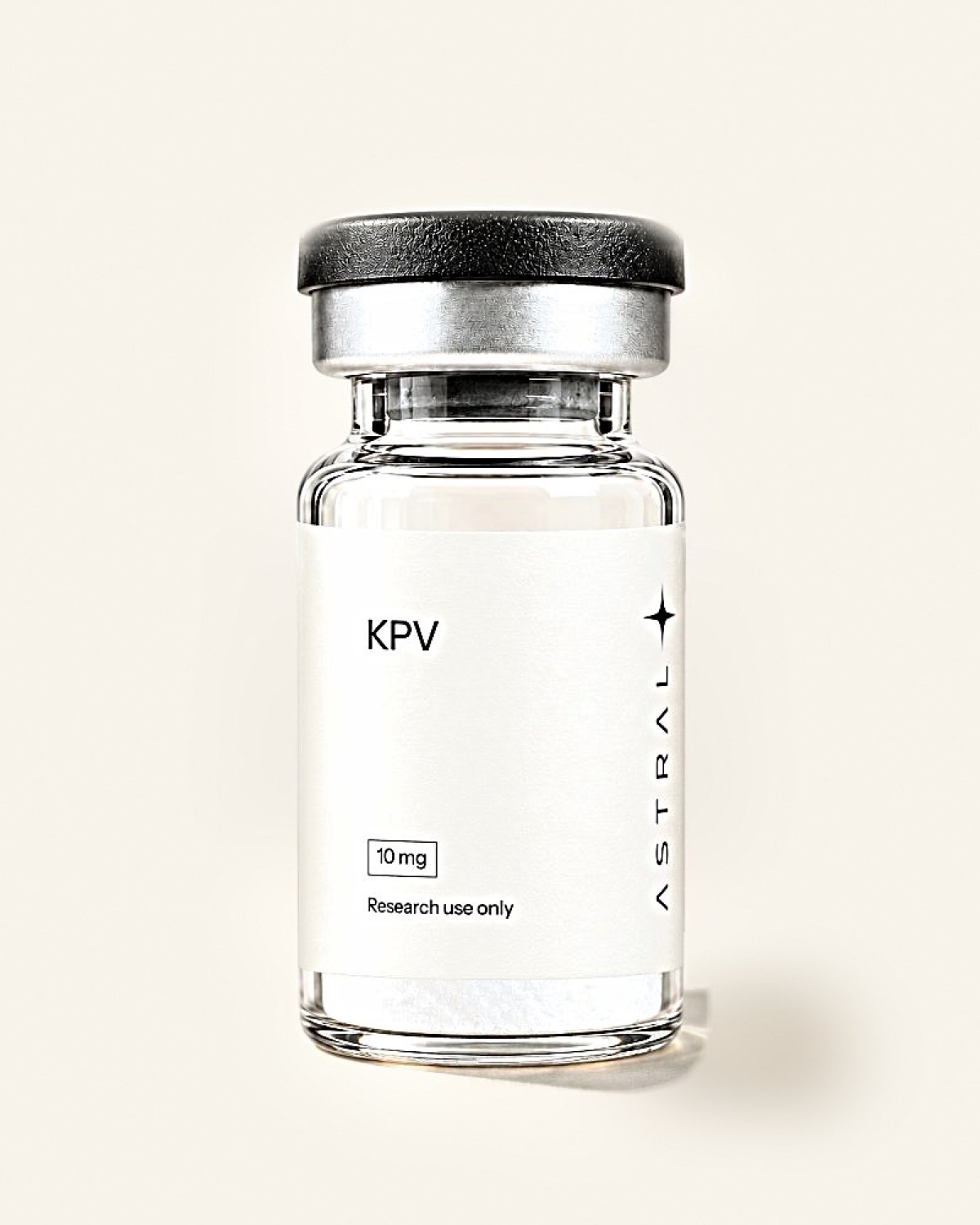
SARMs vs peptides is a question of chemistry before it is anything else. A SARM, short for selective androgen receptor modulator, is a small synthetic molecule designed to bind one protein, the androgen receptor. A peptide is a chain of amino acids joined end to end, like BPC-157, which runs 15 of them. SARMs are not peptides.
The two get lumped together because the same searches turn up both and the names are used loosely. They differ in size, in how they are made, in how they behave in a vial and in how regulators classify them. Astral’s catalog is peptides, from three-residue KPV to 16-residue MOTS-c, and it lists no SARMs. This page sets the two classes next to each other with a source for every line.
Table of contents
What are SARMs?
SARMs are synthetic compounds that bind the androgen receptor, the protein that testosterone and dihydrotestosterone act through. The class dates to 1998, when Dalton and colleagues at the University of Tennessee reported nonsteroidal ligands that bound the receptor about as tightly as dihydrotestosterone and activated it in transcription assays. Their paper opened with a flat sentence: “Nonsteroidal androgens have not been reported.”
Over the following decade that work produced a chemical family called the arylpropionamides. A 2018 review by Narayanan, Coss and Dalton described enobosarm as the member that went furthest in clinical development. Enobosarm is the same compound sold under the names ostarine, MK-2866 and GTx-024. Other SARMs came from other programs, among them LGD-4033 (ligandrol), RAD140 and andarine.
The word “selective” names the design goal. The review described SARMs as ligands meant to activate the receptor “in a tissue-selective manner”. It is a statement about what chemists were aiming for, and it says nothing about any bottle sold online.
What are peptides?
A peptide is two or more amino acids linked by amide bonds, each formed between the carboxyl group of one amino acid and the amino group of the next. That is the ChEBI definition, and the bond has its own name, the peptide bond. Length is what separates a peptide from a protein. FDA regulations draw the line at 40 amino acids, and anything longer with a defined sequence counts as a protein.
Inside that limit the range is wide. KPV is three amino acids, which we cover in What is KPV. BPC-157 is 15. MOTS-c is 16.
One caution about shelves. A product sold beside peptides is not always a peptide. NAD+ is a dinucleotide coenzyme with no amino acid chain at all, and Is NAD+ a peptide walks through that case.
What is the difference between SARMs and peptides at the molecular level?
Size and building blocks. A SARM is one compact molecule a few hundred daltons in mass, assembled from aromatic rings and small functional groups. A peptide is a string of amino acid units, and its mass grows with every unit added. The table puts one well-documented example of each side by side, with values from PubChem.
| Enobosarm (a SARM) | BPC-157 (a peptide) | |
|---|---|---|
| Full name | (2S)-3-(4-cyanophenoxy)-N-[4-cyano-3-(trifluoromethyl)phenyl]-2-hydroxy-2-methylpropanamide | Gly-Glu-Pro-Pro-Pro-Gly-Lys-Pro-Ala-Asp-Asp-Ala-Gly-Leu-Val |
| Other names and codes | Ostarine, MK-2866, GTx-024 | Bepecin, PL-14736 |
| Class | Nonsteroidal androgen receptor ligand (arylpropionamide) | Synthetic peptide, 15 amino acids |
| Amino acids | 0 | 15 |
| Molecular formula | C19H14F3N3O3 | C62H98N16O22 |
| Molar mass | 389.3 g/mol | 1419.5 g/mol |
| CAS number | 841205-47-8 | 137525-51-0 |
| PubChem CID | 11326715 | 9941957 |
Read the formulas and the gap is plain. Enobosarm has 42 atoms. BPC-157 has 198 and weighs about 3.6 times as much. Enobosarm carries three fluorine atoms on a trifluoromethyl group, while BPC-157 is built from carbon, hydrogen, nitrogen and oxygen alone.
A fine point worth getting right: enobosarm does contain an amide bond, as the “propanamide” in its name shows. That bond joins a small acid to an aromatic amine. It does not join two amino acids, so it is not a peptide bond and the molecule is not a peptide.
The other SARMs named above sit in the same weight range. PubChem gives ligandrol 338.25 g/mol, RAD140 393.8 g/mol and andarine 441.4 g/mol. All are under 500, the molecular weight ceiling in Lipinski’s “rule of 5”, a rule of thumb medicinal chemists use for small-molecule drug candidates. BPC-157 is nearly three times over it.
The mass difference matters for arithmetic. Ten milligrams of enobosarm is about 25.7 micromoles. Ten milligrams of BPC-157 is about 7.0 micromoles. Equal weights are not equal numbers of molecules.
| SARMs | Peptides | |
|---|---|---|
| What they are | Small synthetic receptor ligands | Chains of amino acids |
| Typical mass | Roughly 340 to 440 g/mol for the examples above | 342.4 g/mol for the tripeptide KPV, 1419.5 g/mol for BPC-157 |
| How they are made | Conventional organic synthesis | Solid-phase peptide synthesis |
| FDA status | None approved | Decided compound by compound |
| WADA 2026 list | S1.2, other anabolic agents | S2 for peptide hormones, with some named in S0 and S4 |
Are SARMs steroids?
The SARMs discussed here are nonsteroidal, which is the word the literature uses for them. Testosterone, C19H28O2, is built on a fused four-ring steroid skeleton that shows up in its systematic name as “cyclopenta[a]phenanthren”. Enobosarm, ligandrol and RAD140 have no such ring system. They bind the same receptor with a different scaffold. WADA files them accordingly: anabolic androgenic steroids go in section S1.1, and SARMs go in S1.2, “other anabolic agents”.
How are SARMs and peptides made?
SARMs come out of conventional organic synthesis. The 1998 Tennessee paper describes its compounds simply as ligands the group synthesized in its own laboratory.
Peptides are assembled one amino acid at a time. The standard method is solid-phase peptide synthesis, which Bruce Merrifield described in 1963 in a paper on the synthesis of a tetrapeptide. The first amino acid is attached to a solid polymer, the chain is extended on it step by step, and byproducts are washed away after each step. Only at the end is the finished peptide cut free. Merrifield received the 1984 Nobel Prize in Chemistry “for his development of methodology for chemical synthesis on a solid matrix”.
How is each handled at the bench?
Most research peptides ship lyophilized, meaning freeze-dried, because they keep far better as a dry powder than in solution. Our storage guide puts it this way: peptides are “more fragile than most small-molecule compounds”. Their structure is what heat, moisture, light and oxygen work against. Before use the powder goes back into solution with a solvent such as Reconstitution Solution. The steps are in How to reconstitute peptides, the windows for freezer and fridge are in the peptide storage guide, and the peptide calculator handles the mg/mL math.
Small molecules behave differently in solvent, and one computed number shows why. PubChem lists a predicted octanol-water partition value, XLogP, of 2.7 for enobosarm and −9 for BPC-157. A positive value marks a compound that favors an oily phase over water. A strongly negative one marks a compound that favors water. The peptide is the water-loving molecule of the two, which is why a water-based solvent suits it.
Is everything sold as a SARM actually a SARM?
No, and loose labeling is a large part of the confusion. A 2017 study in JAMA bought 44 products marketed online as SARMs and analyzed them. Only 23, or 52%, contained a SARM. Another 17 contained a different unapproved compound, including ibutamoren, GW501516 and SR9009. In only 18 of the 44 did the amount found match the label.
Those three are regularly called SARMs and none of them is one. Ibutamoren, also written MK-677, was described by Merck chemists in 1995 as a growth hormone secretagogue. GW501516 is a PPARδ agonist. SR9009 is a Rev-erb agonist. None targets the androgen receptor, and WADA lists each in a different section from the SARMs.
What is the regulatory status of SARMs and peptides?
For SARMs the record is short. No SARM is FDA approved. In an April 2023 consumer update the FDA said SARMs “are considered unapproved drugs” and “cannot be legally marketed in the U.S. as a dietary supplement or drug at this time”. The agency also said it has sent warning letters to companies selling them and has pursued criminal actions against distributors. Enobosarm reached phase II and phase III trials without an approval. The 2026 WADA Prohibited List bans SARMs at all times under S1.2 and names andarine, enobosarm, LGD-4033, RAD140, S-23 and YK-11.
For peptides there is no single answer, because “peptide” is a chemical category. More than 80 peptide drugs have reached the market since insulin, by one 2021 count in Nature Reviews Drug Discovery. Many research peptides have no approval anywhere. The WADA list reflects that spread. Section S2 covers peptide hormones and growth factors and names CJC-1295, ipamorelin, tesamorelin, and thymosin beta-4 with “its derivatives e.g. TB-500”. MOTS-c appears under S4.4, metabolic modulators. BPC-157 is named in S0, the section for substances “with no current approval by any governmental regulatory health authority for human therapeutic use”.
Astral lists several of those compounds as research material: TB-500, CJC-1295 with ipamorelin, tesamorelin, MOTS-c and BPC-157. The companion guides What is TB-500, CJC-1295 and ipamorelin and What is tesamorelin cover what each name means.
Common questions
Are SARMs peptides?
No. SARMs are small synthetic molecules with no amino acid chain. Enobosarm, for example, has the formula C19H14F3N3O3 and a molar mass of 389.3 g/mol, while a peptide such as BPC-157 is 15 amino acids and 1419.5 g/mol.
What are SARMs?
SARMs are selective androgen receptor modulators, synthetic compounds designed to bind the androgen receptor. The first nonsteroidal examples were reported in 1998 by a University of Tennessee group. None is FDA approved.
What is the difference between SARMs and peptides?
A SARM is a single small molecule made by organic synthesis and aimed at one receptor. A peptide is a chain of amino acids joined by peptide bonds, usually made by solid-phase synthesis and supplied as a freeze-dried powder.
Are SARMs steroids?
The well-known SARMs are nonsteroidal. They bind the androgen receptor but lack the four-ring steroid skeleton of testosterone, and WADA lists them under “other anabolic agents”, apart from anabolic androgenic steroids.
Is MK-677 a SARM or a peptide?
MK-677, or ibutamoren, is not a SARM. It was described in 1995 as a growth hormone secretagogue and does not target the androgen receptor. WADA lists it in section S2 among growth hormone secretagogues and their mimetics.
Are SARMs or peptides FDA approved?
No SARM is FDA approved, and the FDA considers SARM products unapproved drugs. Peptides vary one by one. More than 80 peptide drugs have reached the market, and many research peptides have no approval.
The full list of peptides Astral supplies is in the catalog.
Sources
- Dalton JT, Mukherjee A, Zhu Z, Kirkovsky L, Miller DD Discovery of nonsteroidal androgens. Biochemical and Biophysical Research Communications (1998)
- Narayanan R, Coss CC, Dalton JT Development of selective androgen receptor modulators (SARMs). Molecular and Cellular Endocrinology (2018)
- Van Wagoner RM, Eichner A, Bhasin S, Deuster PA, Eichner D Chemical composition and labeling of substances marketed as selective androgen receptor modulators and sold via the internet. JAMA (2017)
- FDA warns of use of selective androgen receptor modulators (SARMs) among teens, young adults U.S. Food and Drug Administration (2023)
- World Anti-Doping Agency World Anti-Doping Code International Standard, Prohibited List (2026)
- Compound records for enobosarm, BPC-157, ligandrol, RAD140, andarine, ibutamoren and testosterone PubChem, National Library of Medicine (2026)
- ChEBI, European Bioinformatics Institute Peptide (CHEBI:16670) (2026)
- Code of Federal Regulations, 21 CFR 600.3(h)(6), definition of protein, 2026
- Merrifield RB. Solid phase peptide synthesis. I. The synthesis of a tetrapeptide. Journal of the American Chemical Society 1963. (1963)
- Solid phase peptide synthesis, summary The Nobel Prize in Chemistry (1984)
- Muttenthaler M, King GF, Adams DJ, Alewood PF Trends in peptide drug discovery. Nature Reviews Drug Discovery (2021)
- Lipinski CA, Lombardo F, Dominy BW, Feeney PJ Experimental and computational approaches to estimate solubility and permeability in drug discovery and development settings. Advanced Drug Delivery Reviews (2001)
- Patchett AA, Nargund RP, Tata JR, et al Design and biological activities of L-163,191 (MK-0677): a potent, orally active growth hormone secretagogue. Proceedings of the National Academy of Sciences (1995)
- Solomon ZJ, Mirabal JR, Mazur DJ, et al Selective androgen receptor modulators: current knowledge and clinical applications. Sexual Medicine Reviews (2019)