Glutathione Peptide: Is Glutathione a Peptide?
Glutathione is a tripeptide with one bond in an unusual place. Here is the structure, the two forms it comes in, and why the difference matters at the bench.
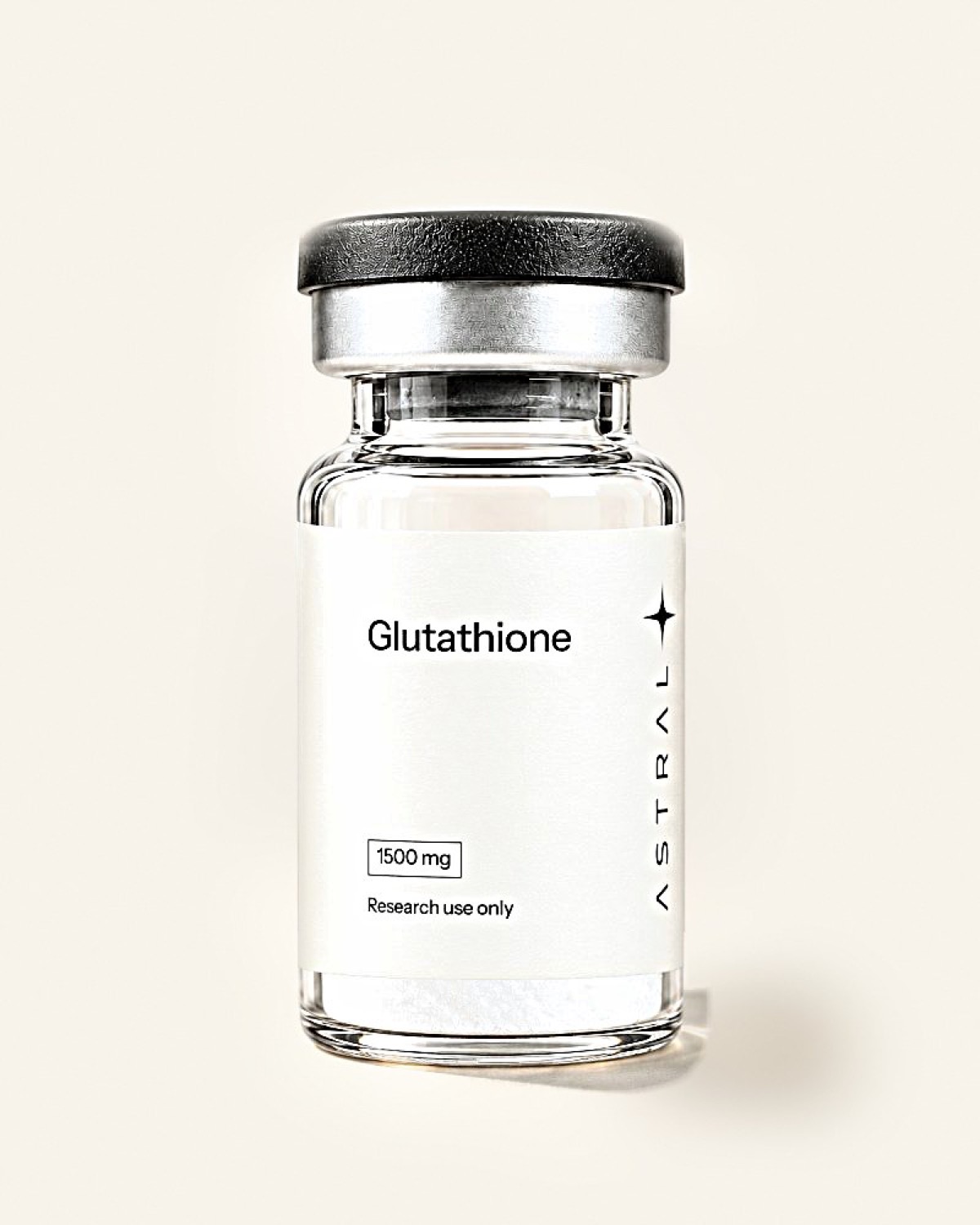
Yes. Glutathione is a peptide, a tripeptide made of three amino acids, glutamate, cysteine and glycine, joined in that order. The phrase “glutathione peptide” is accurate, with one footnote: the first of its two bonds runs through the side chain of glutamate, a gamma linkage that most peptides do not have.
Astral lists Glutathione as a freeze-dried powder in a 1500 mg vial, CAS 70-18-8, in the reduced form known as GSH. This page covers what the molecule is, why the gamma bond does not cost it the name, how the reduced and oxidized forms differ, and why that difference matters once the powder is in solution.
| Item | Value |
|---|---|
| Full name | γ-L-Glutamyl-L-cysteinylglycine |
| Other names | Glutathione, L-glutathione, reduced glutathione, GSH |
| Class | Tripeptide, thiol |
| Sequence | γ-Glu-Cys-Gly |
| Length | 3 amino acids |
| Molecular formula | C10H17N3O6S |
| Molar mass | 307.33 g/mol (PubChem). Data sheets also round it to 307.32 or 307.3 |
| CAS number | 70-18-8 |
| PubChem CID | 124886 |
| ChEBI ID | CHEBI:16856 |
| Oxidized form | Glutathione disulfide (GSSG), CAS 27025-41-8, PubChem CID 65359 |
Table of contents
Is glutathione a peptide or an amino acid?
It is a peptide. An amino acid is a single building block, and glutathione is three of them held together by two amide bonds. The international nomenclature rules for amino acids and peptides, written by the joint IUPAC-IUB commission, define a peptide as any compound made by forming an amide between the carboxyl group of one amino acid and the amino group of another. Glutathione fits that definition twice.
There are three fair reasons the question still gets asked. One of its bonds sits in an odd position. Cells put it together with two dedicated enzymes, one bond at a time. And it is also sold as a dietary ingredient. None of the three changes the chemistry.
The nomenclature rules settle the first point directly. They say the word peptide usually refers to chains bonded from carbon 1 of one amino acid to the alpha nitrogen of the next, and that it also covers residues linked by other amide bonds, which are sometimes called isopeptide bonds. Then, when the same document shows how to write out a peptide’s name and formula, the example it picks is glutathione.
Is it a protein? No. Under the same rules a chain is usually called a protein only past about 50 residues, and glutathione has three.
What is the structure of glutathione?
Glutathione is glutamate bonded to cysteine bonded to glycine, written γ-Glu-Cys-Gly. The Greek letter is the part worth understanding.
Glutamate has two carboxyl groups. One sits on the alpha carbon, next to the amino group, and that is the one every ordinary peptide bond uses. The other sits at the far end of the side chain, on the gamma carbon. In glutathione the bond to cysteine is made through the gamma carboxyl. Shelly Lu’s 2013 review of glutathione synthesis called the structure unique for that reason. The second bond, from cysteine to glycine, is a conventional one.
Two things follow from the geometry. Glutamate keeps both its alpha amino group and its alpha carboxyl group free, so one end of the molecule looks like a whole, unbonded amino acid. And the gamma bond is hard for enzymes to cut. Lu’s review reported that a single enzyme, γ-glutamyltranspeptidase, can hydrolyze it, and that the enzyme sits on the outer surface of certain cell types.
The middle residue supplies the chemistry glutathione is known for. Cysteine’s side chain ends in a thiol, a sulfur atom carrying one hydrogen, and ChEBI classifies glutathione as a thiol as well as a tripeptide. Everything in the sections on GSH and GSSG below comes down to what that sulfur is bonded to.
What amino acids are in glutathione?
Three: glutamic acid (glutamate), cysteine and glycine, one of each. Cells assemble them in two steps that each consume ATP. The first enzyme, glutamate-cysteine ligase, joins glutamate to cysteine through the gamma bond. The second, glutathione synthetase, adds glycine. Lu’s review described glutathione as present in all mammalian tissues at 1 to 10 millimolar, with the highest concentration in the liver, and as the most abundant thiol in those tissues outside of proteins.
The count of three took decades to get right. In 1888 de Rey-Pailhade described a substance in yeast extracts that reduced sulfur to hydrogen sulfide and named it philothion. In 1921 Frederick G. Hopkins isolated it from yeast and animal tissue, named it glutathione, and reported it as a dipeptide of glutamate and cysteine. Other groups doubted the dipeptide. In 1929 Hopkins revised his own result and showed a tripeptide that included glycine, and in 1935 C. R. Harington and T. H. Mead published a chemical synthesis in the Biochemical Journal.
Reduced vs oxidized glutathione: what is GSH vs GSSG?
GSH is one glutathione molecule with its thiol free. GSSG is two glutathione molecules joined sulfur to sulfur by a disulfide bond. They are different compounds with different formulas, masses and CAS numbers.
| GSH | GSSG | |
|---|---|---|
| Name | Reduced glutathione, L-glutathione | Glutathione disulfide, oxidized glutathione |
| What it is | One tripeptide with a free thiol | Two tripeptides joined by a disulfide bond |
| Molecular formula | C10H17N3O6S | C20H32N6O12S2 |
| Molar mass | 307.33 g/mol | 612.6 g/mol |
| CAS number | 70-18-8 | 27025-41-8 |
| PubChem CID | 124886 | 65359 |
The arithmetic shows the relationship. Two GSH molecules come to 614.66 g/mol, and GSSG is 612.6. The gap is two hydrogen atoms, one lost from each thiol when the sulfurs bond to each other.
Inside cells the reduced form dominates. Lu’s review put GSH at more than 98 percent of total glutathione and described the cycle that keeps it there: GSSG is reduced back to GSH by the enzyme GSSG reductase at the expense of NADPH. NADPH is the reduced form of NADP+, a phosphate-carrying relative of the NAD+ covered in Is NAD+ a peptide?. A 2001 review by Schafer and Buettner called the pair the most abundant redox couple in a cell and proposed using its state as an indicator of the cell’s redox environment.
On labels, “L-glutathione”, “reduced glutathione” and “GSH” all mean the 70-18-8 molecule. “Oxidized glutathione” and “GSSG” mean the disulfide. Astral’s product page states that its Glutathione is the reduced form.
Why does oxidation matter at the bench?
Because the reduced form can turn into the oxidized form in the vial after you add liquid, and the two are different reagents. A free thiol is reactive. In water with dissolved oxygen, pairs of GSH molecules can join into GSSG.
Trace metal speeds this up. A 1998 study by Kachur, Koch and Biaglow followed copper-catalyzed oxidation of glutathione by measuring oxygen consumption and thiol loss. It reported that copper formed a catalytic complex with glutathione and that the first phase of the reaction consumed one mole of oxygen for every four moles of thiol. Air and stray metal ions are the two inputs to keep away from a solution.
The data sheets draw the practical line. Cayman Chemical’s product information for reduced glutathione gives the solid a storage temperature of −20 °C with stability of at least 4 years, and says it does not recommend storing an aqueous solution for more than one day. That is far shorter than the general window for mixed peptides in our peptide storage guide, which sets a ceiling of 28 days at 2 to 8 °C and singles out cysteine-containing peptides as sensitive to oxygen. Glutathione is the cysteine case in its plainest form. If an experiment depends on the thiol, mix close to the time of use, keep the vial sealed and cold, and treat an old solution as a mixture of GSH and GSSG of unknown proportions.
Published solubility figures vary widely. PubChem lists 292.5 mg/mL in water, citing the Human Metabolome Database, and Cayman’s sheet works at about 20 mg/mL. Plan the volume before the liquid goes in.
The molar math is simple because the molecule is small. At 307.33 g/mol, a 1500 mg vial holds about 4.88 millimoles of GSH. Fully oxidized, the same material would be about 2.44 millimoles of GSSG. Our peptide calculator converts any vial and volume to mg/mL, How to reconstitute peptides has the steps, and Reconstitution Solution is the solvent Astral stocks for freeze-dried powders.
How does glutathione compare with other tripeptides?
Glutathione is one of three tripeptides in the Astral catalog, and it is the only one with a gamma bond or a thiol. KPV is Lys-Pro-Val, the last three residues of the hormone α-MSH, and GHK-Cu is Gly-His-Lys carrying one copper(II) ion. Both use ordinary alpha peptide bonds.
| Glutathione | KPV | GHK-Cu | |
|---|---|---|---|
| Sequence | γ-Glu-Cys-Gly | Lys-Pro-Val | Gly-His-Lys, with Cu²⁺ |
| Bonds | One gamma, one alpha | Two alpha | Two alpha |
| Distinguishing feature | Free thiol on cysteine | Tail of α-MSH | Bound copper ion |
| Astral vial | 1500 mg | 10 mg | 50 mg |
Each has its own page: What is KPV peptide and What is GHK-Cu. NAD+ sits beside all three in the catalog and belongs to a different class of molecule. It is a dinucleotide coenzyme with no amino acids in it.
For the reduced form in a 1500 mg vial, see Glutathione in the catalog.
Common questions
Is glutathione a peptide?
Yes. Glutathione is a tripeptide, three amino acids joined by two amide bonds. One of those bonds is a gamma linkage through glutamate’s side chain, and the IUPAC-IUB nomenclature rules still count it as a peptide.
What amino acids is glutathione made of?
Glutamic acid, cysteine and glycine, one of each, in that order. The full chemical name is γ-L-glutamyl-L-cysteinylglycine.
What is the difference between GSH and GSSG?
GSH is reduced glutathione, a single tripeptide with a free thiol, 307.33 g/mol. GSSG is glutathione disulfide, two of those tripeptides joined by a sulfur-sulfur bond, 612.6 g/mol.
Is reduced glutathione the same as L-glutathione?
Yes. Reduced glutathione, L-glutathione and GSH are three names for the same molecule, CAS 70-18-8. Oxidized glutathione, GSSG, is a different compound with CAS 27025-41-8.
Why is the bond in glutathione called a gamma bond?
Because glutamate is attached to cysteine through the carboxyl group on its gamma carbon, at the end of the side chain, where an ordinary peptide bond would use the alpha carboxyl.
Is glutathione a protein?
No. It has three residues, and the nomenclature rules reserve “protein” for chains of more than about 50.
Sources
- Glutathione, compound summary (CID 124886) PubChem, National Library of Medicine
- Glutathione disulfide, compound summary (CID 65359) PubChem, National Library of Medicine
- Glutathione (CHEBI:16856) ChEBI, EMBL-EBI
- Nomenclature and Symbolism for Amino Acids and Peptides, Recommendations 1983, sections 3AA-11 to 3AA-13 IUPAC-IUB Joint Commission on Biochemical Nomenclature
- Glutathione synthesis Lu SC. Biochimica et Biophysica Acta (2013)
- Redox environment of the cell as viewed through the redox state of the glutathione disulfide/glutathione couple Schafer FQ, Buettner GR. Free Radical Biology and Medicine (2001)
- Mechanism of copper-catalyzed oxidation of glutathione Kachur AV, Koch CJ, Biaglow JE. Free Radical Research (1998)
- Glutathione in the Brain Aoyama K. International Journal of Molecular Sciences (2021)
- Synthesis of glutathione Harington CR, Mead TH. Biochemical Journal (1935)
- L-Glutathione, reduced, product information, item 10007461 Cayman Chemical (2025)
- FDA highlights concerns with using dietary ingredient glutathione to compound sterile injectables U.S. Food and Drug Administration (2019)